
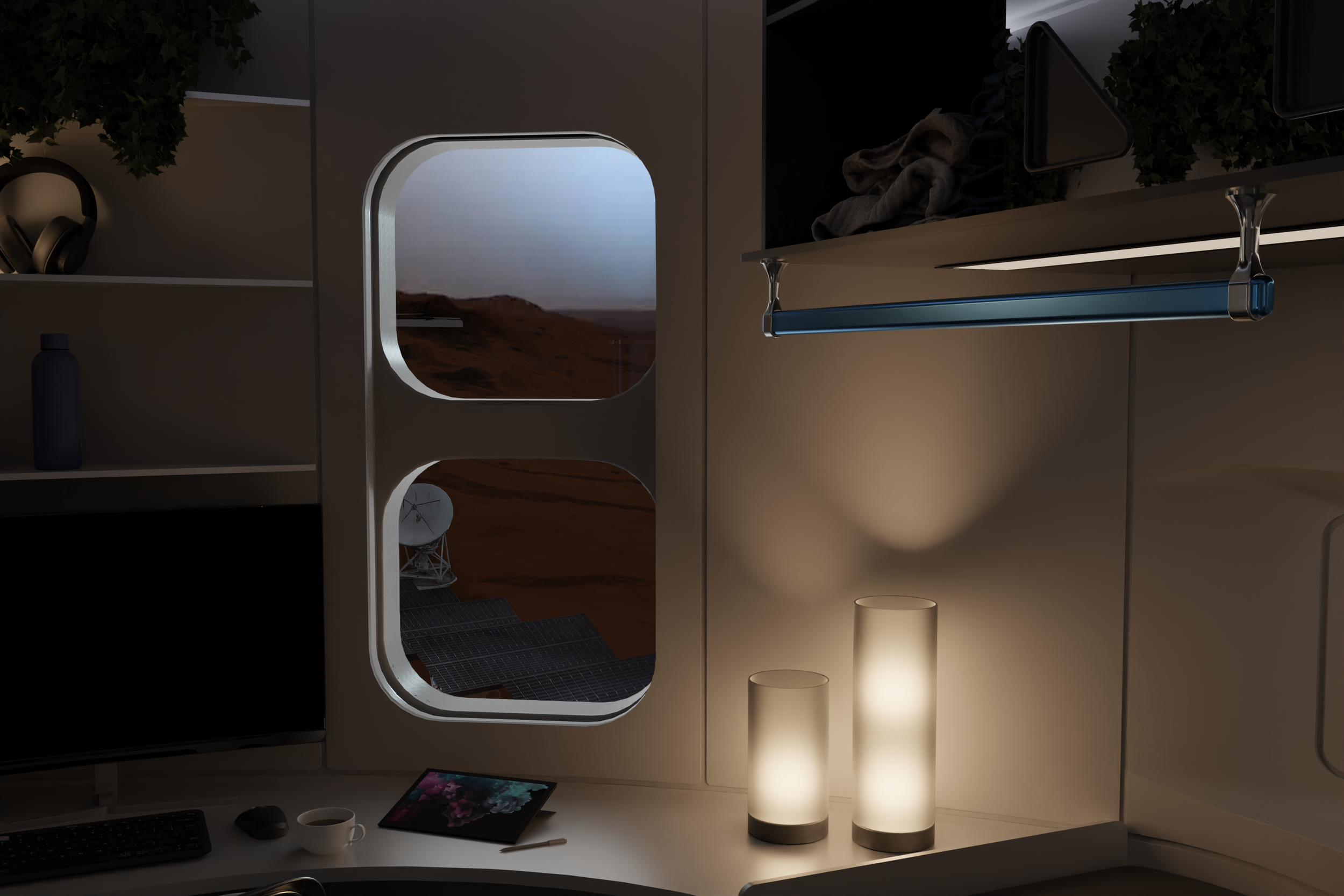
Mars Habitat
_________________________________________
Crew Quarters Module
Objective
Design an analog for a Mars habitat which accommodates a crew of 4 for long-duration missions (months to years), to be constructed in Iceland, to meet the needs of Iceland Space Agency. The habitat should closely represent a Martian habitat with as few differences as possible, given that it will be used here on Earth for terrestrial analog studies.
This project was a part of a 15-person group project (9 weeks) in RISD’s Design for Extreme Environments class, funded through the Rhode Island Space Grant. Unless otherwise specified in captions, all work shown is my own or work I contributed to in a substantive manner.
Most of my work was within a subteam focused on the design of the crew quarters module.
-
Crew Quarters Team: Myself (Bennett Graff), Alex Liu, Rumei Zha, Vincent Zhang, Waverly Huang
Other teammates: Aditri Arun, Anthony Chen, Isabel Obolensky, Kaeli Li, Moran Zheng, Olivia Petrarcha, Rick Fan, Sam Zhan
Mission Architecture
As a guiding principle, we set out to design the habitat first and then adapt the analog from Martian constraints to construction in Iceland.
The analog is a concept to be built on Iceland’s volcanic ash fields as a simulant for the Martian environment. Our design is focusing on the second stage of a habitat that would be added to over successive missions.
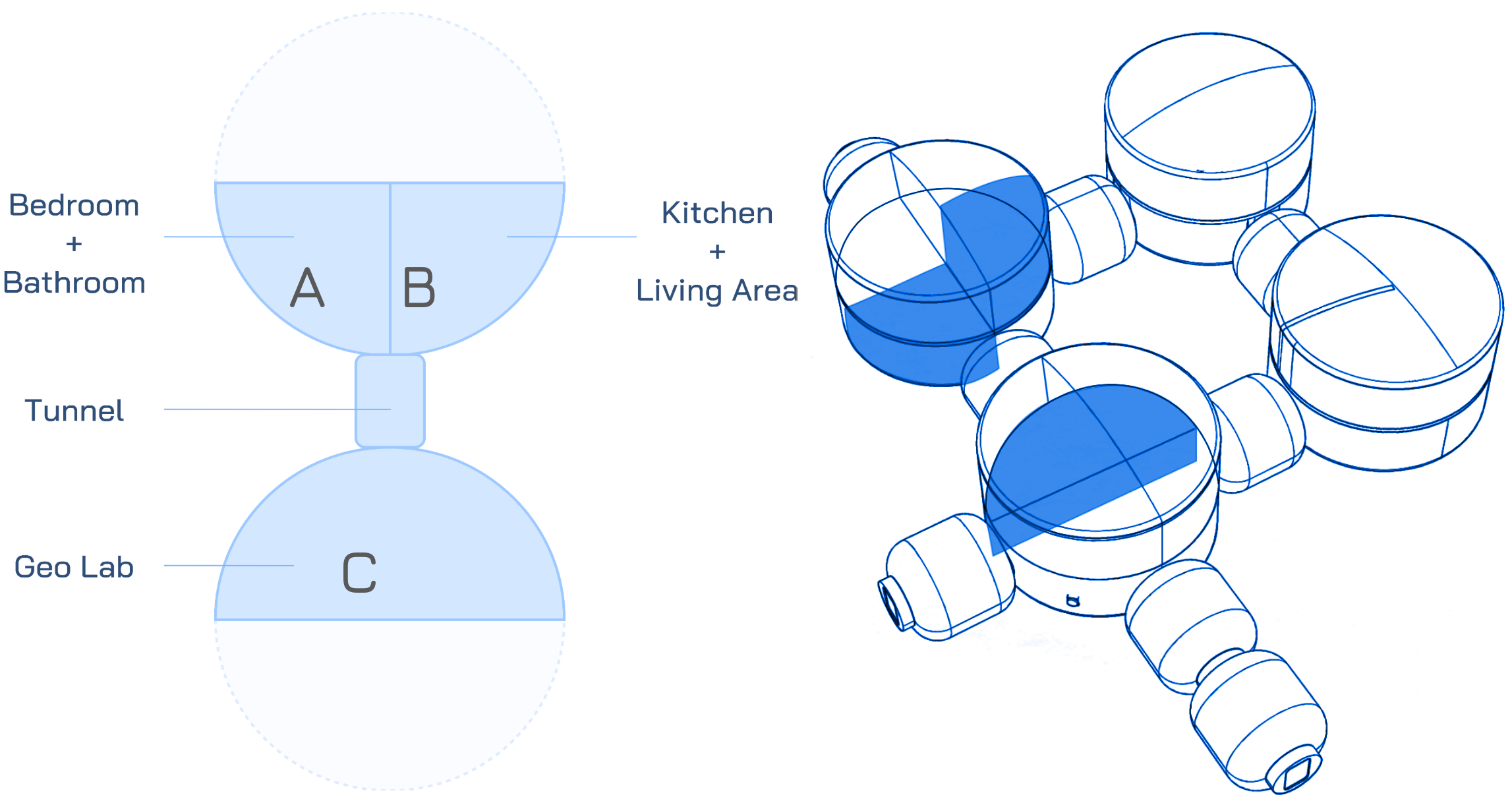
The habitat uses a combination of 8-meter-wide rigid modules and inflatable passageway modules to connect them. It assumes a SpaceX Starship or comparable launch vehicle, with two payloads devoted to each mission’s habitat or expansion.
The project does not propose a solution for arranging modules once landed at the desired site.
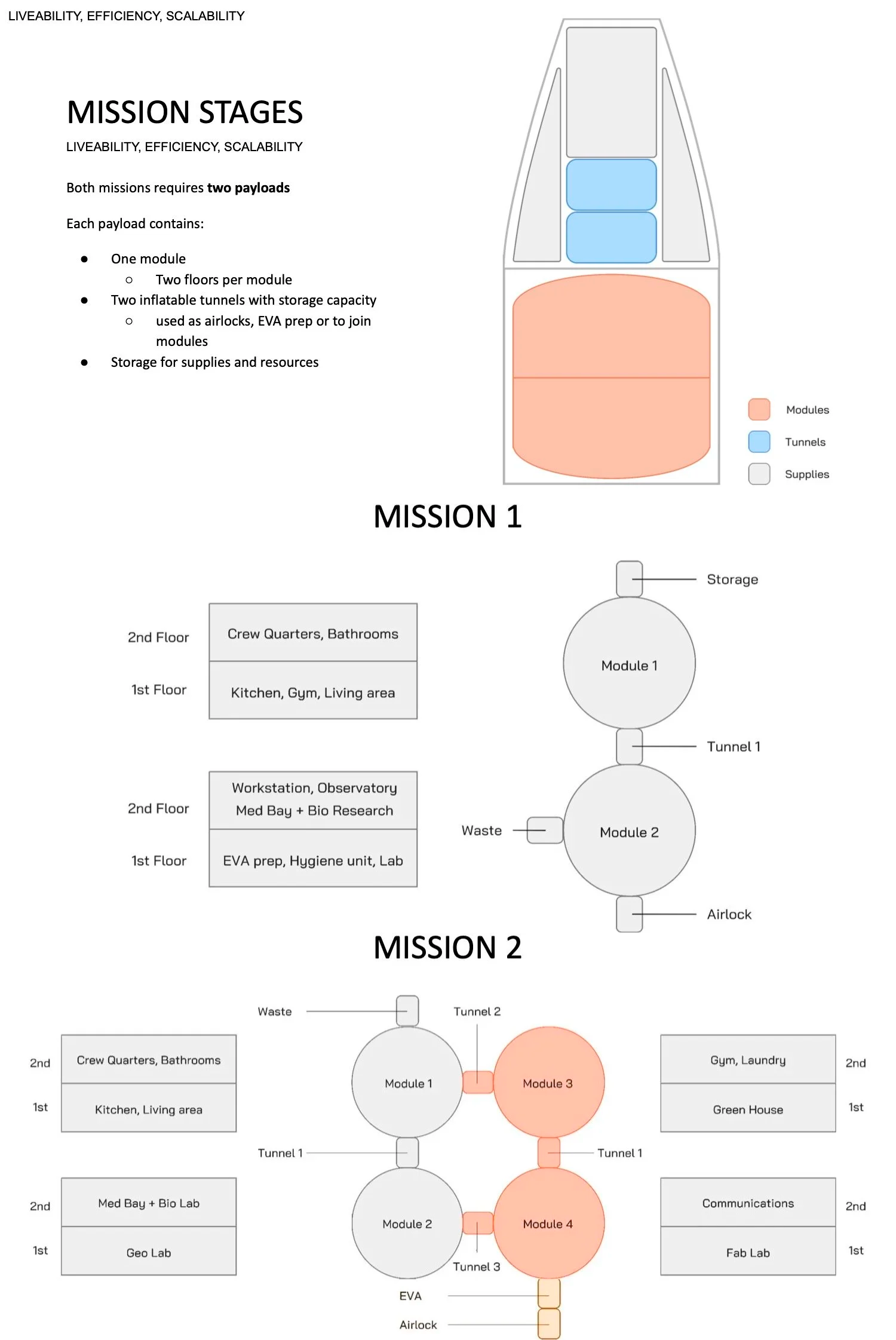
excerpted from the team’s final presentation, diagrams are not my own
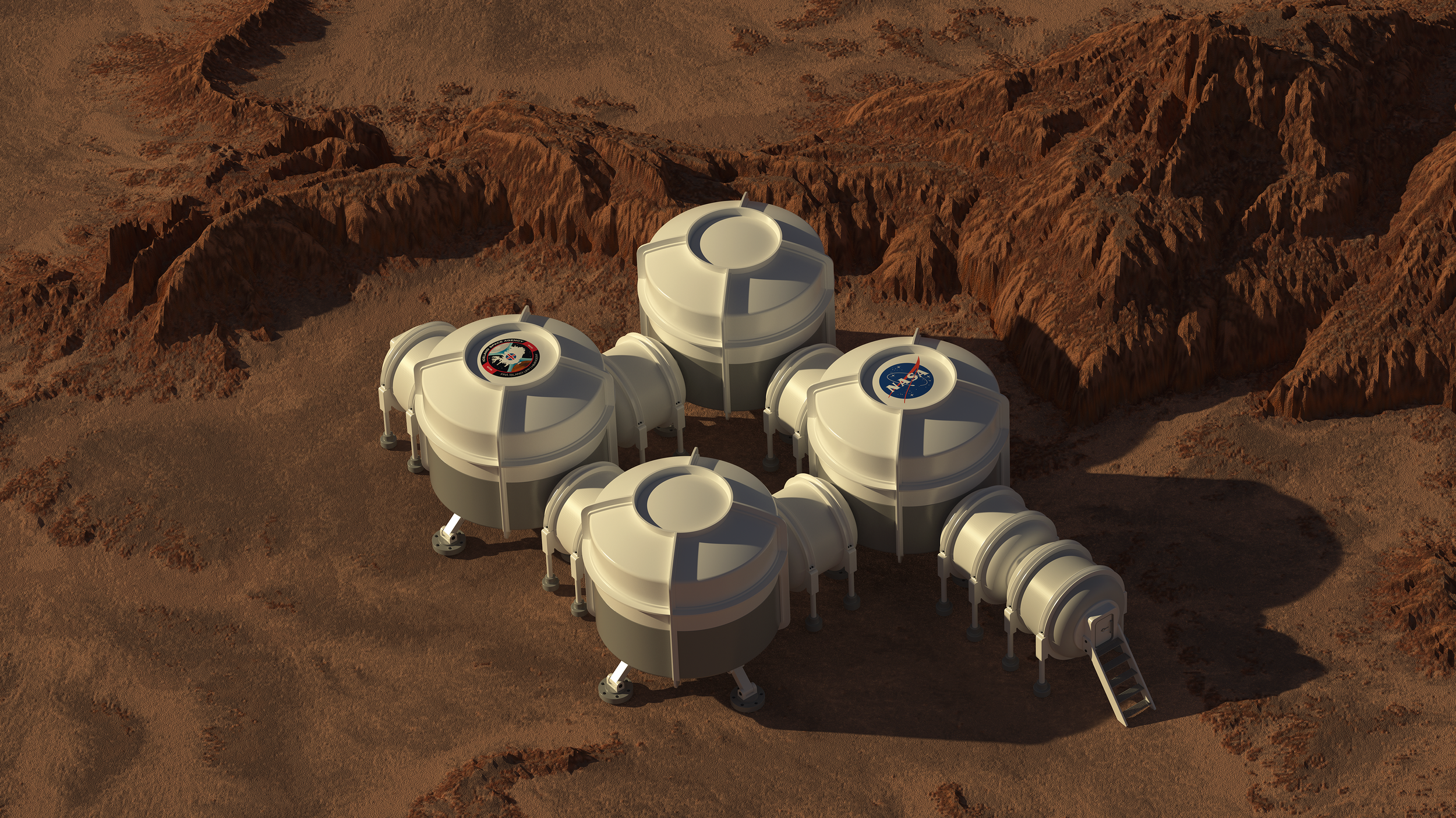
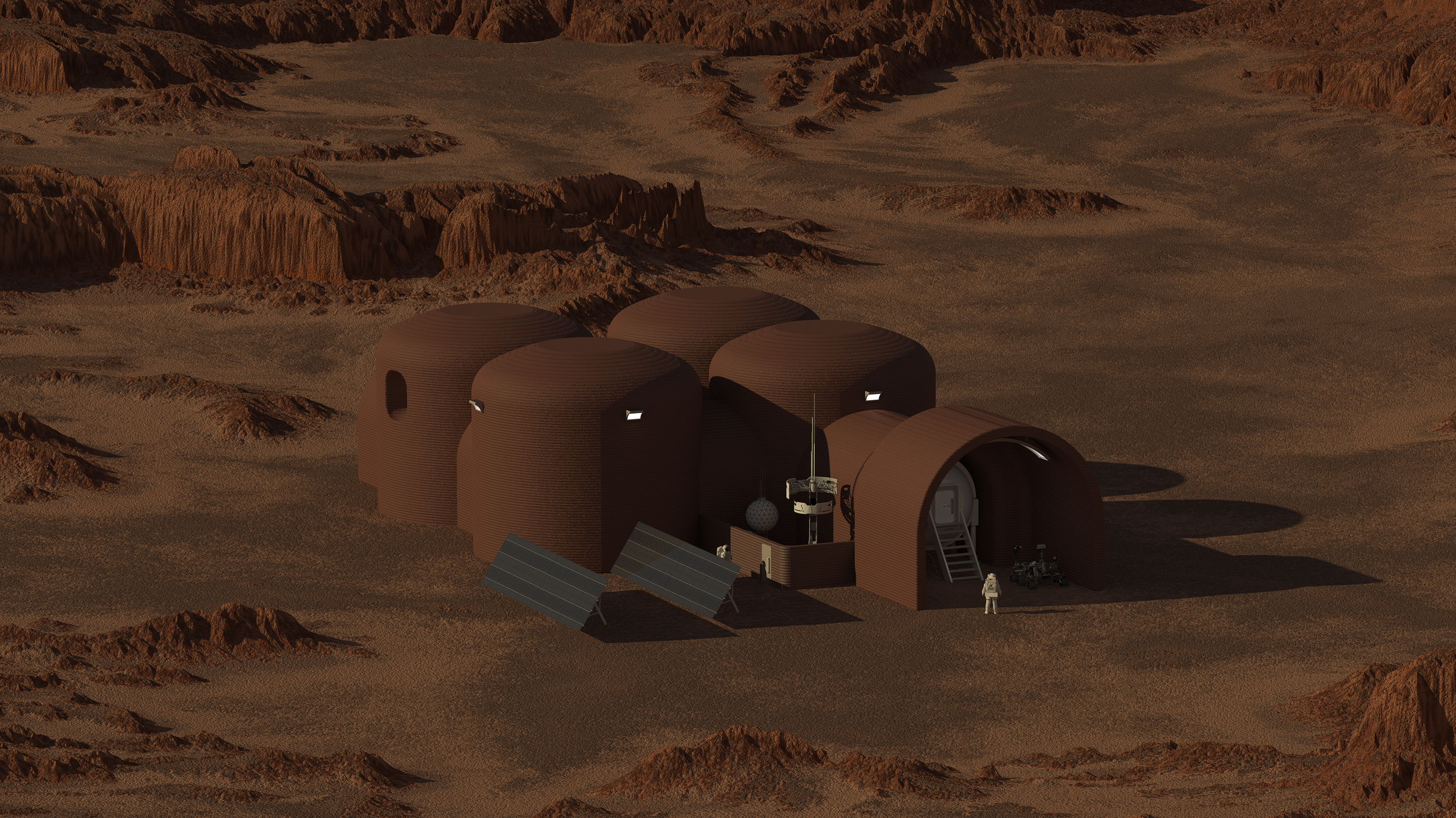
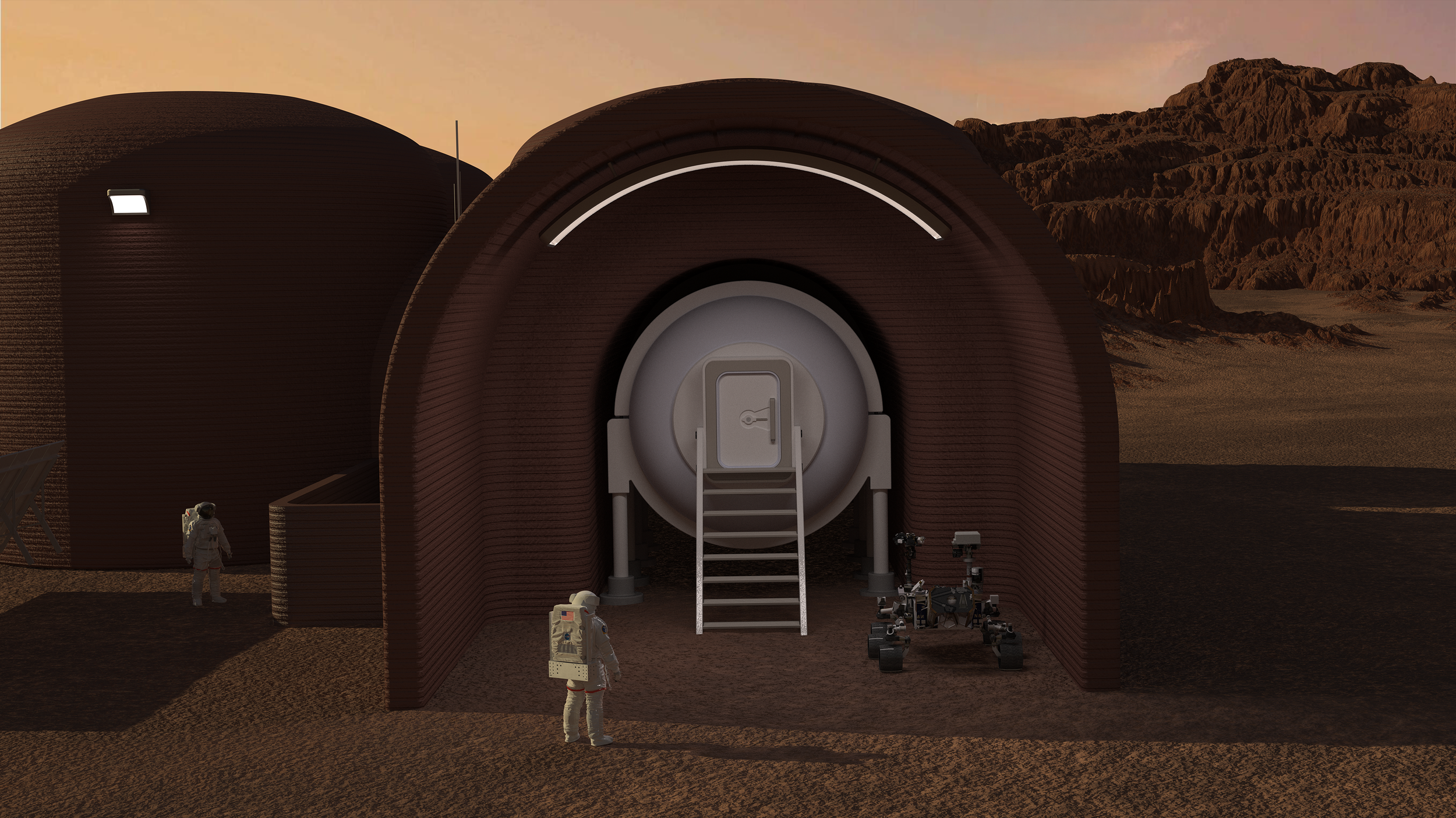
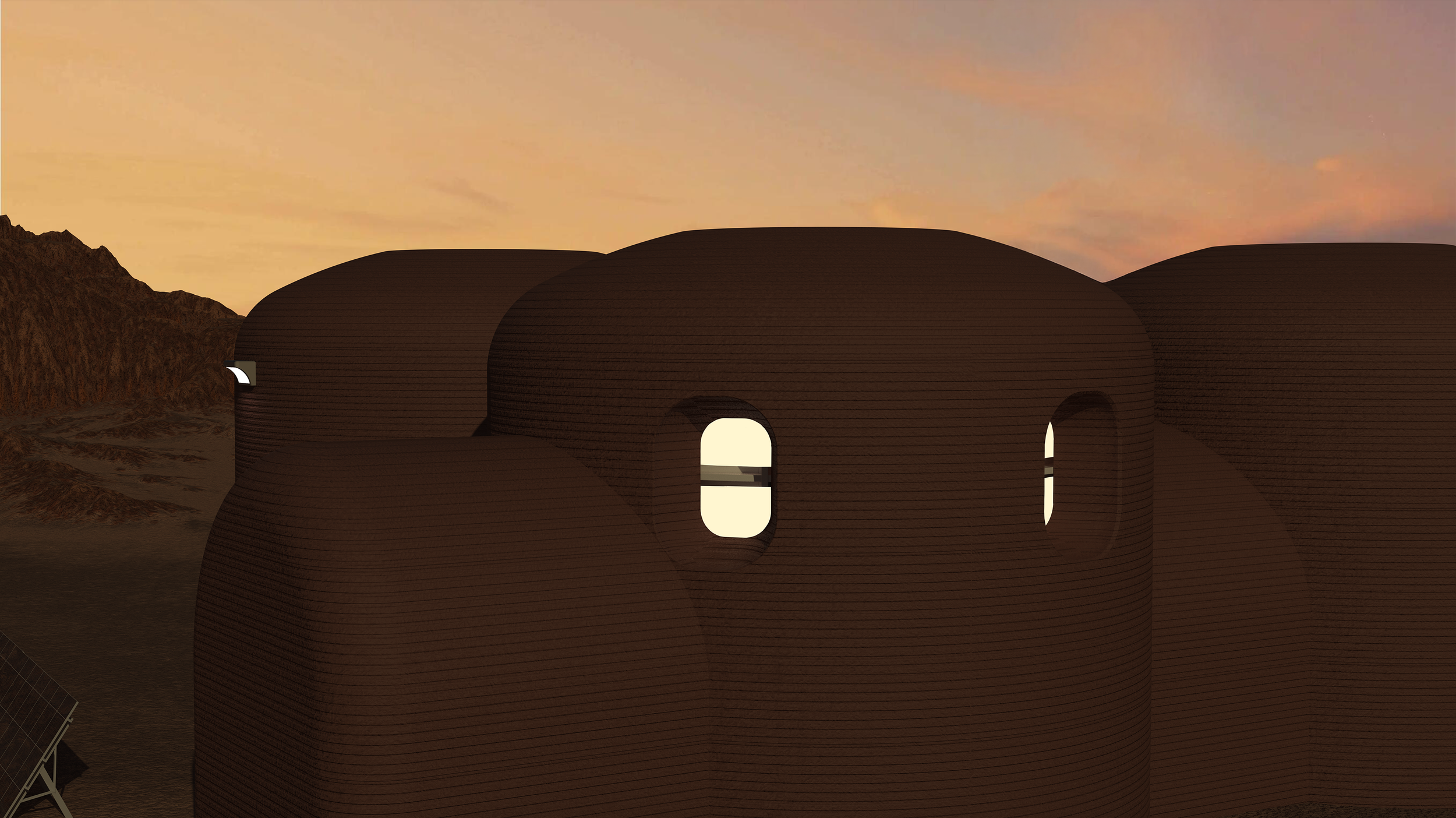
Exterior renders above by Rick Fan ↑
Full-scale Prototyping
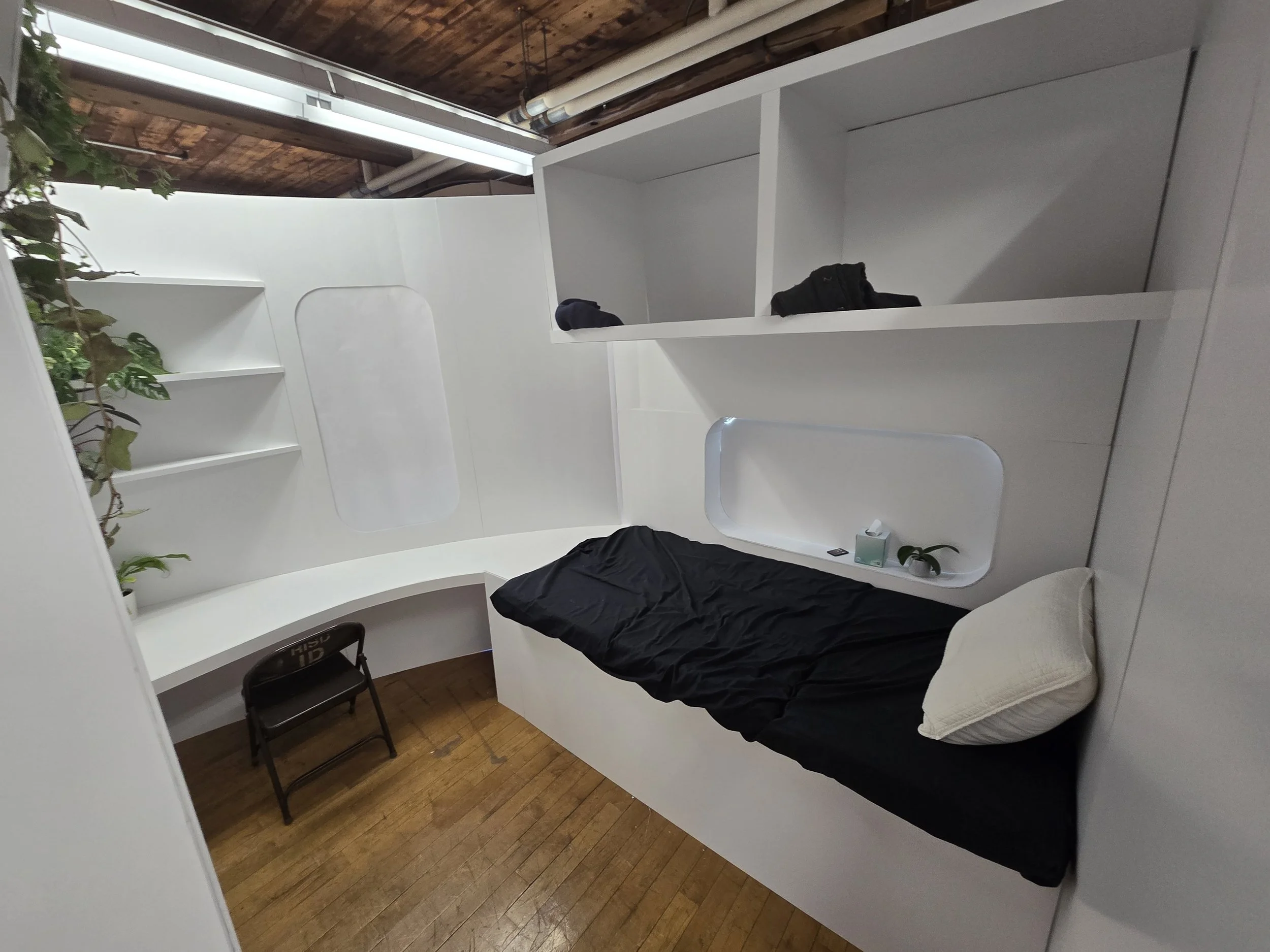
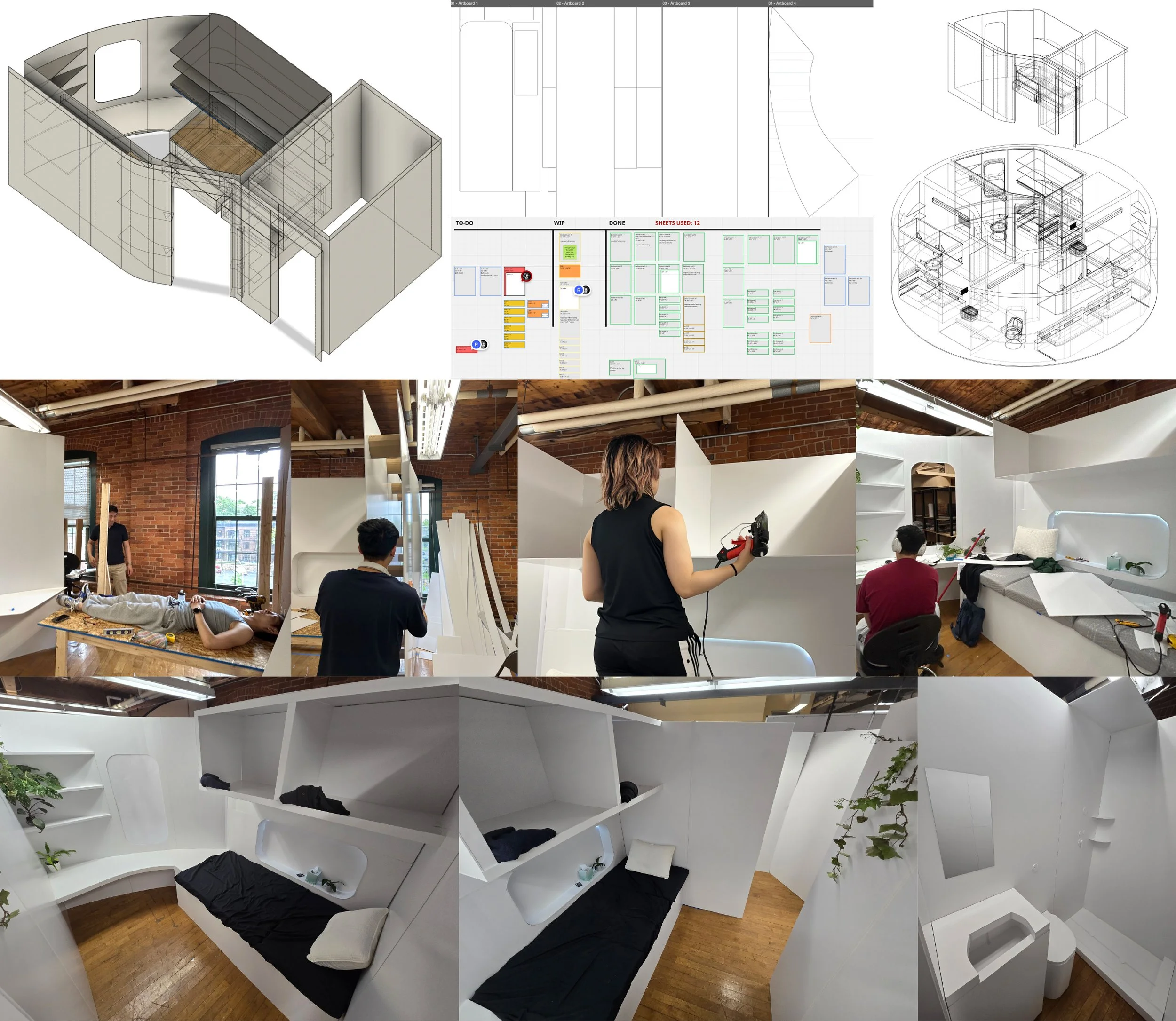
To inform our design and process, we built a full-scale model of segments of the habitat.
Crew Quarters Module
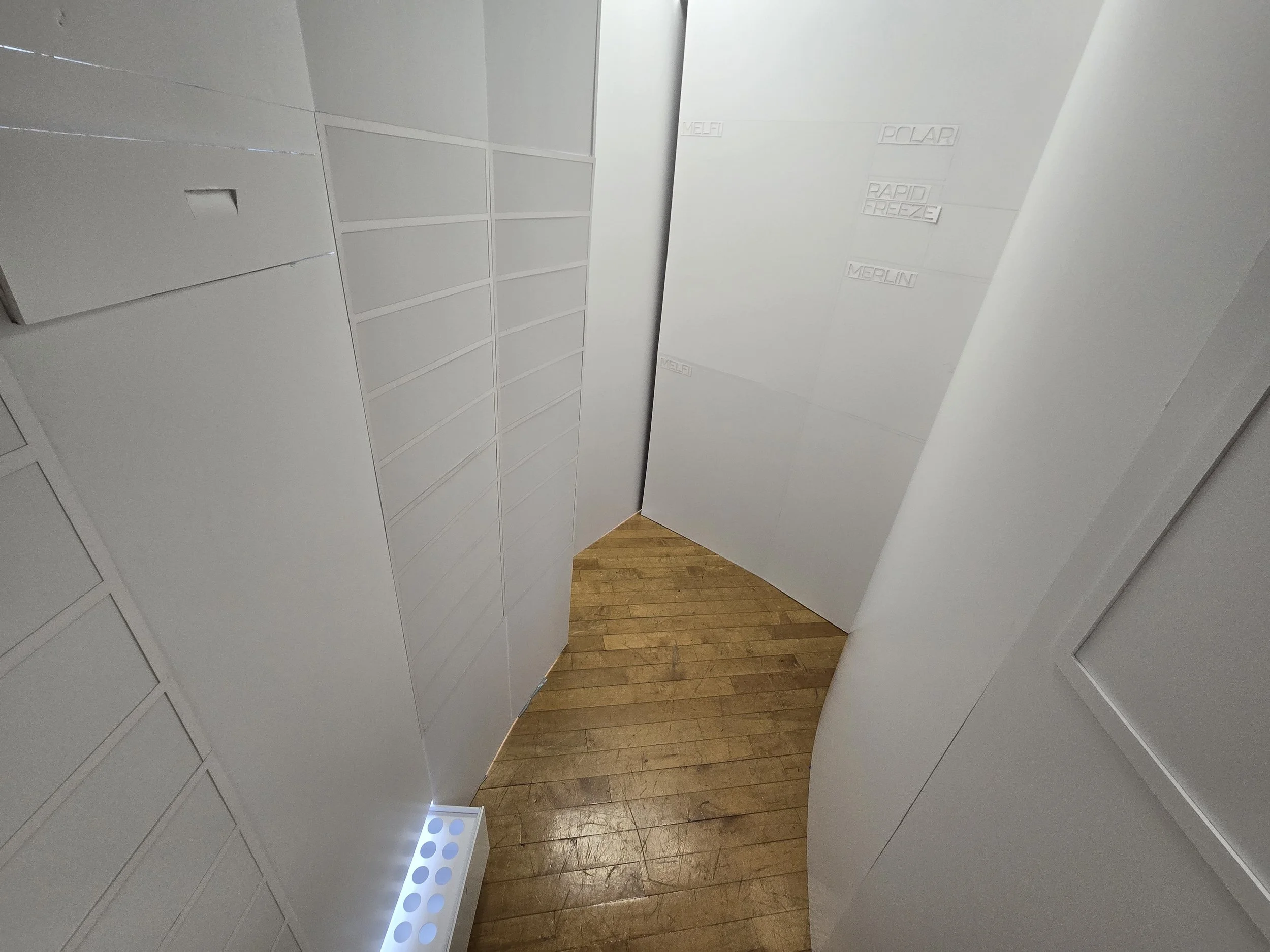
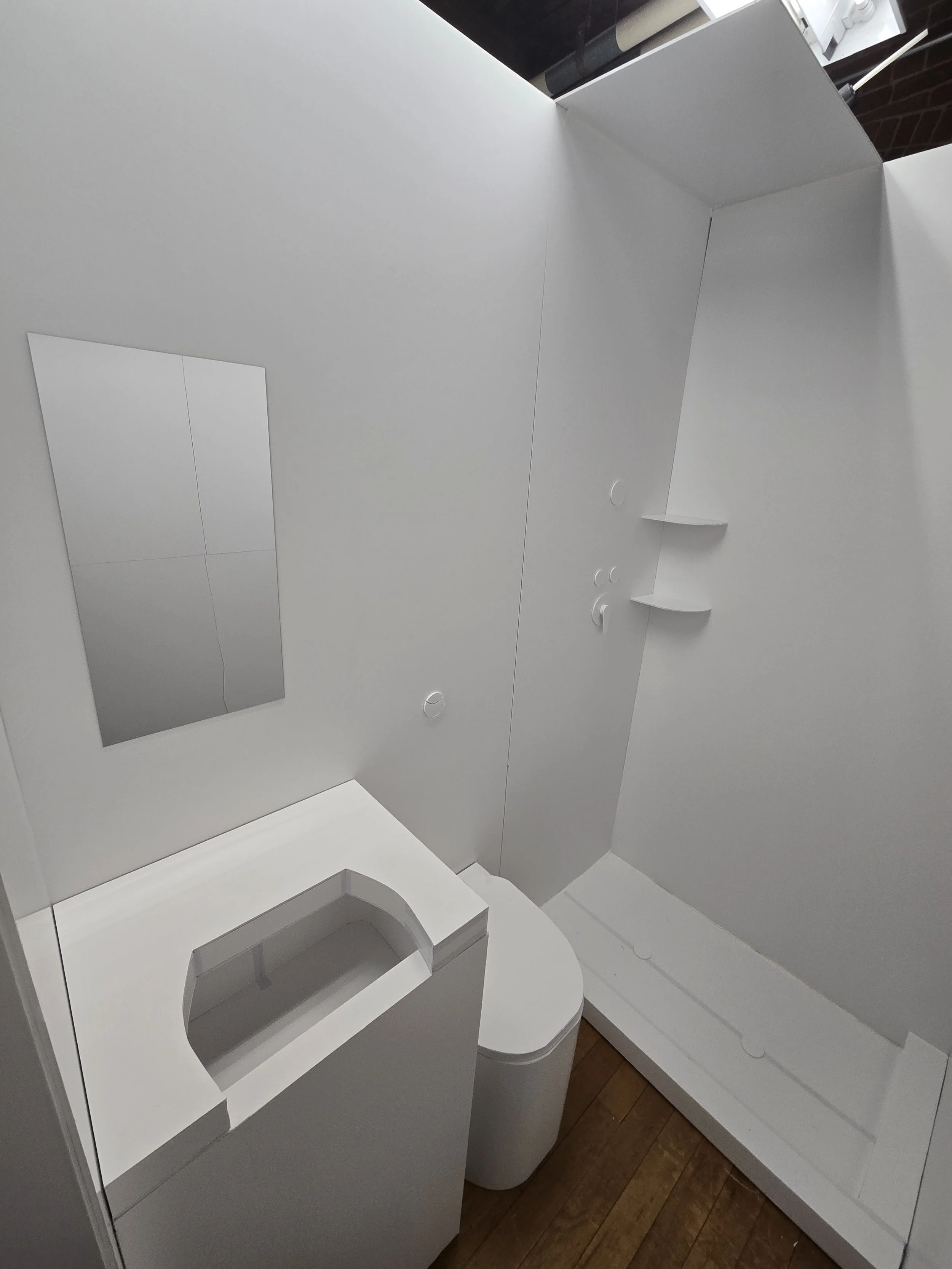
Geology Lab, Galley, & Passageway
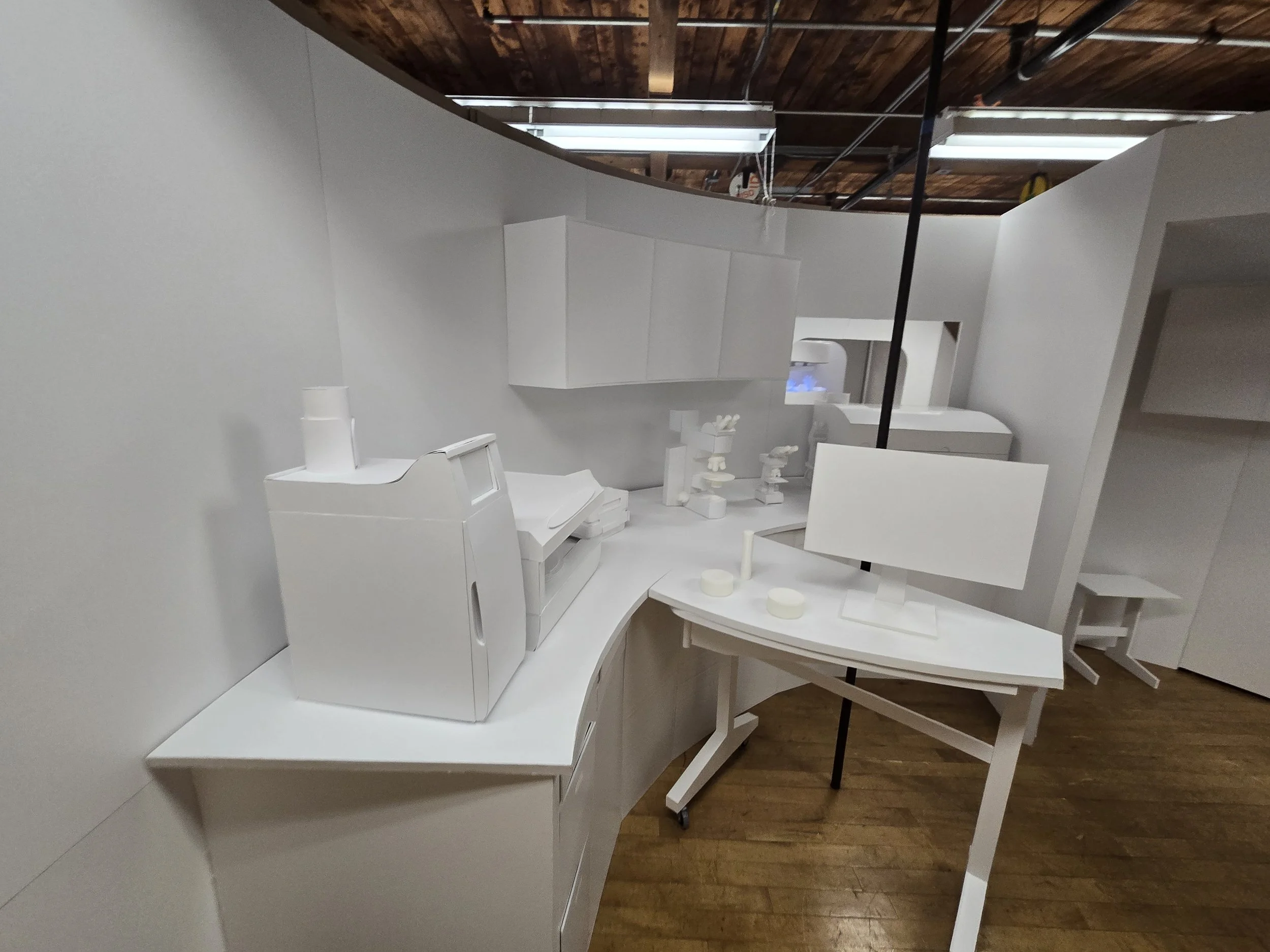
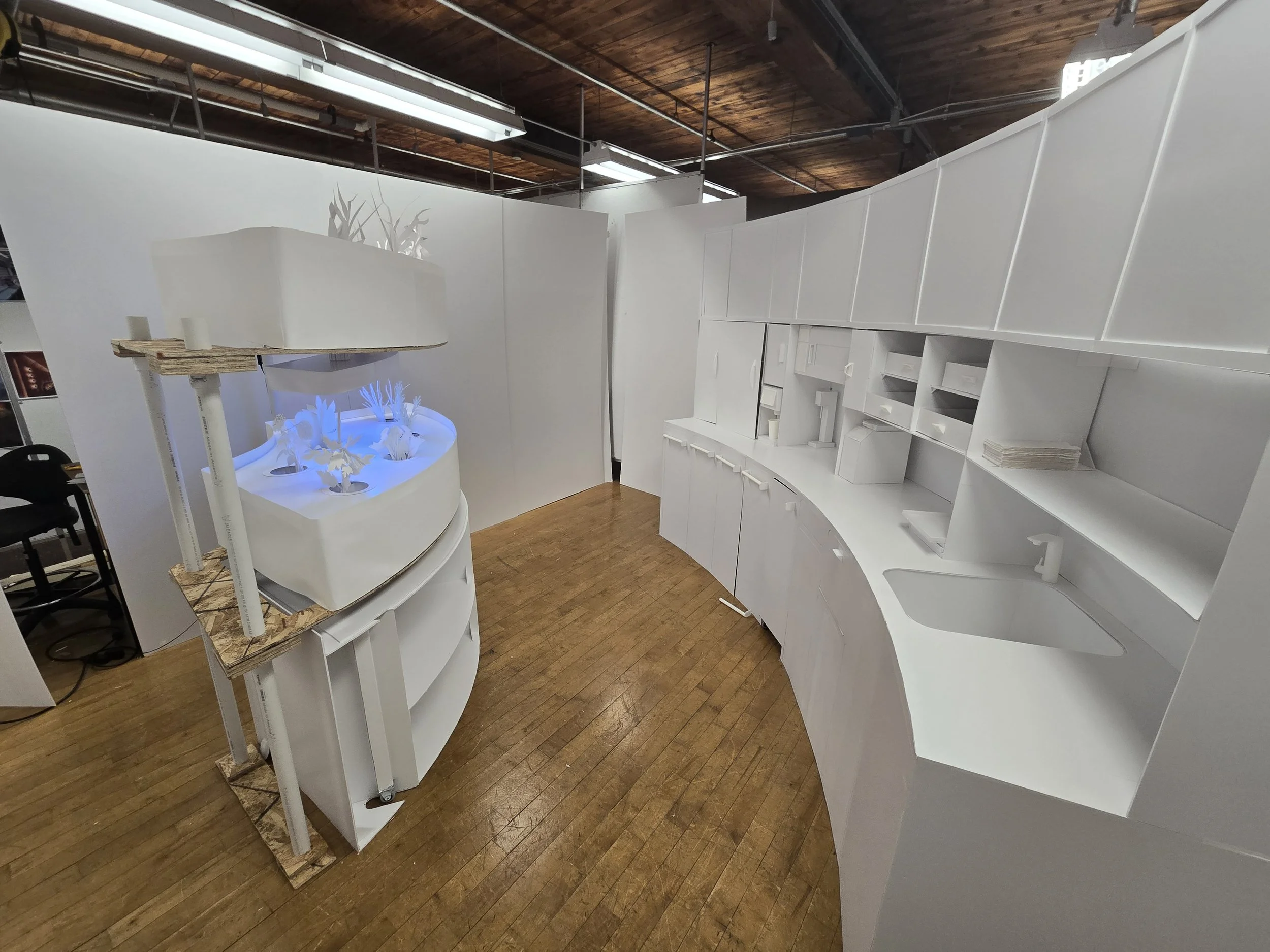
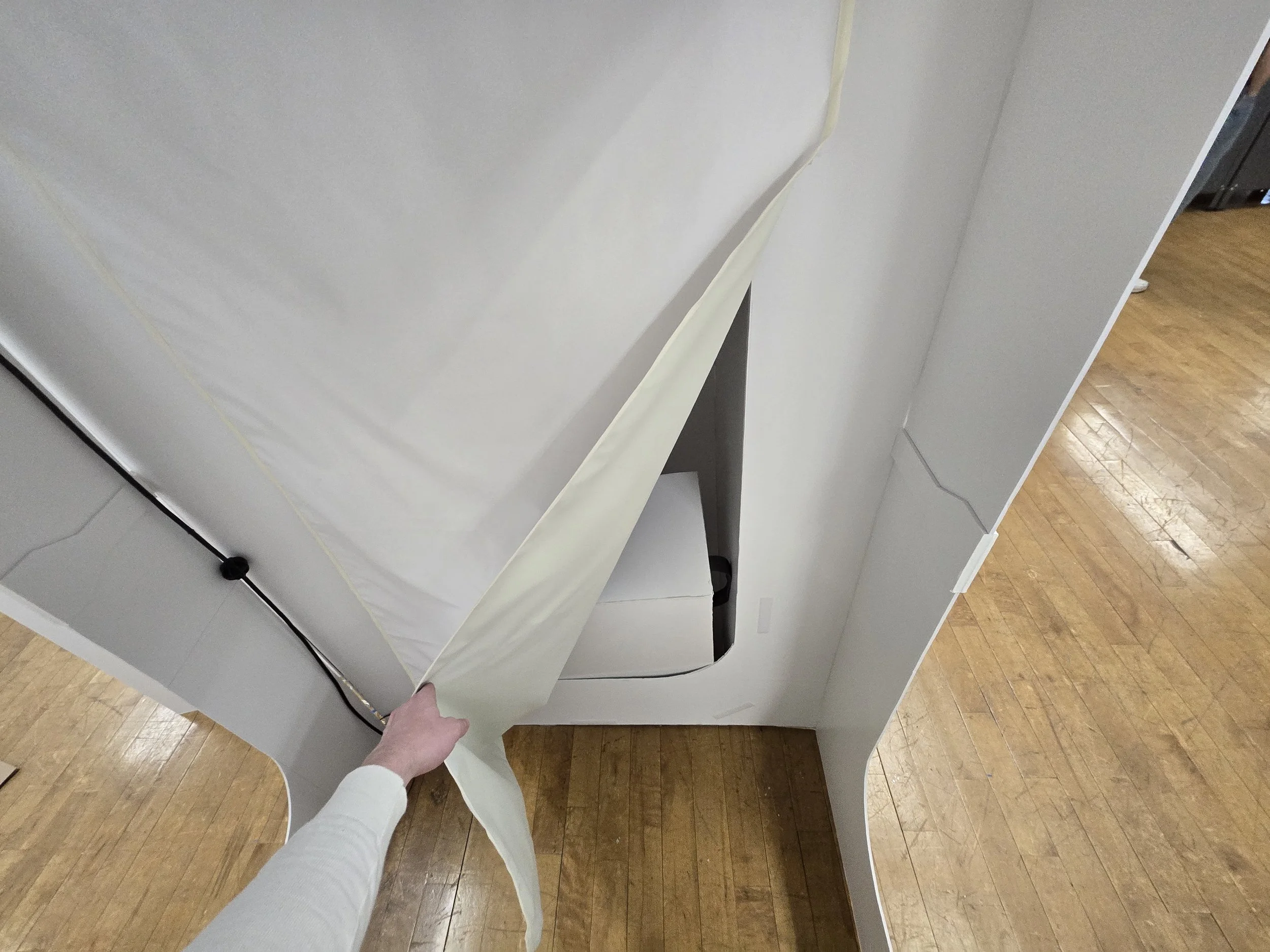
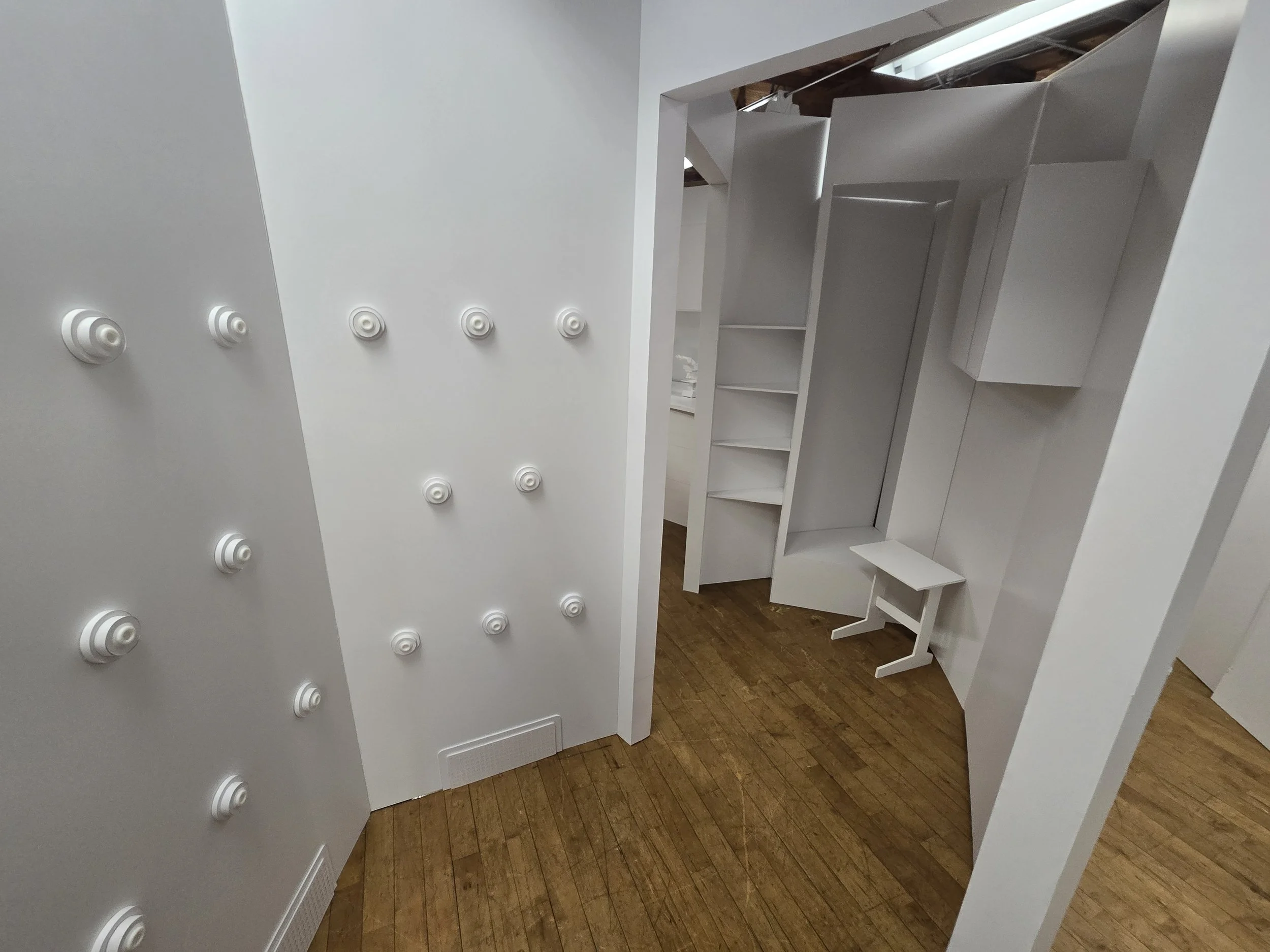
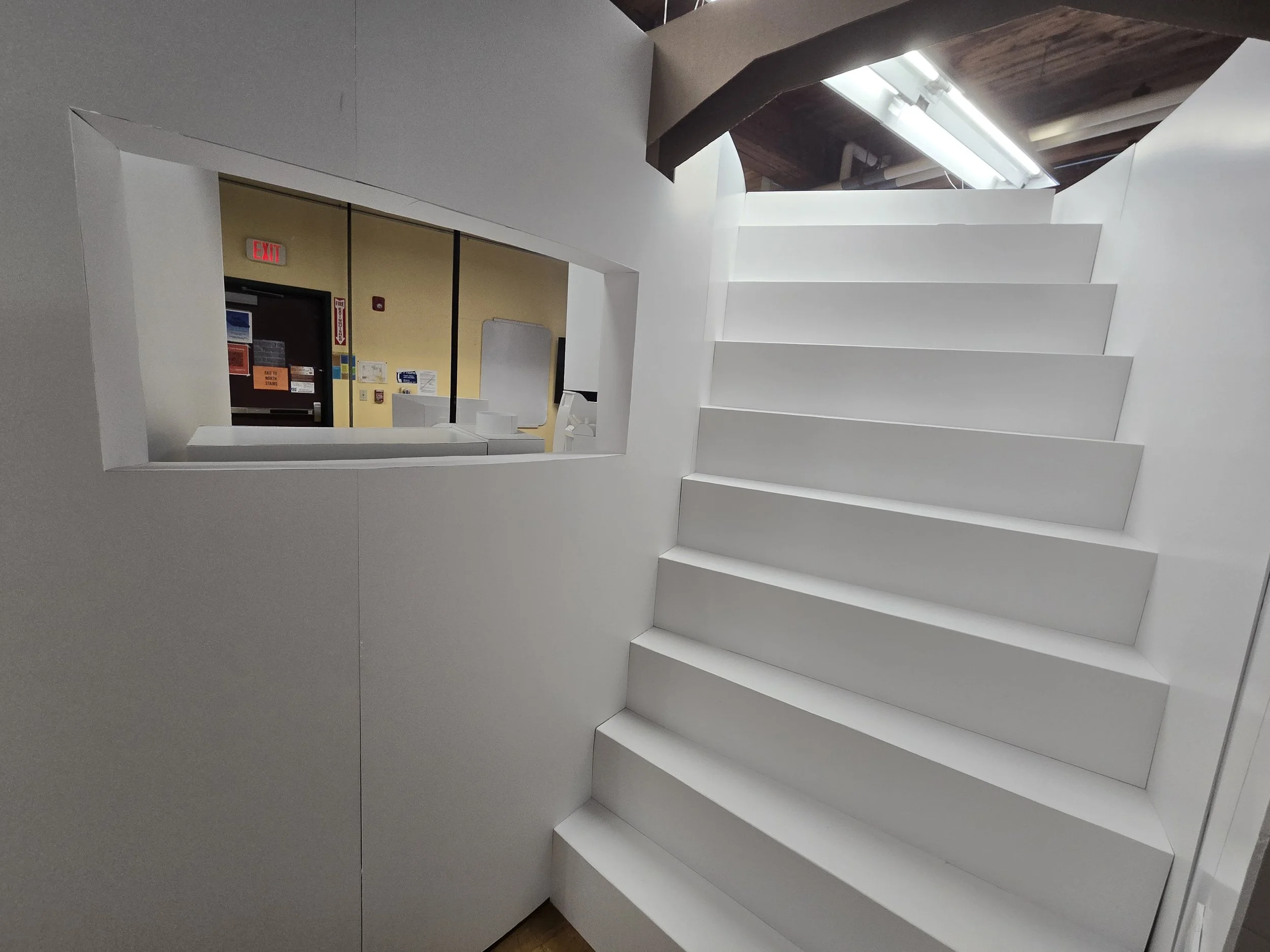
Top Left: geology lab space with proposed equipment layout, top middle: storage for lab space, top right: air shower/decontamination, bottom left: galley with necessary food preparation appliances and storage, a garden, and stowable dining table, bottom middle: shortened passageway mockup with stowage space, bottom right: stairway from geo lab/passageway to medical bay and bio lab

Crew Quarters Module Floor Plan
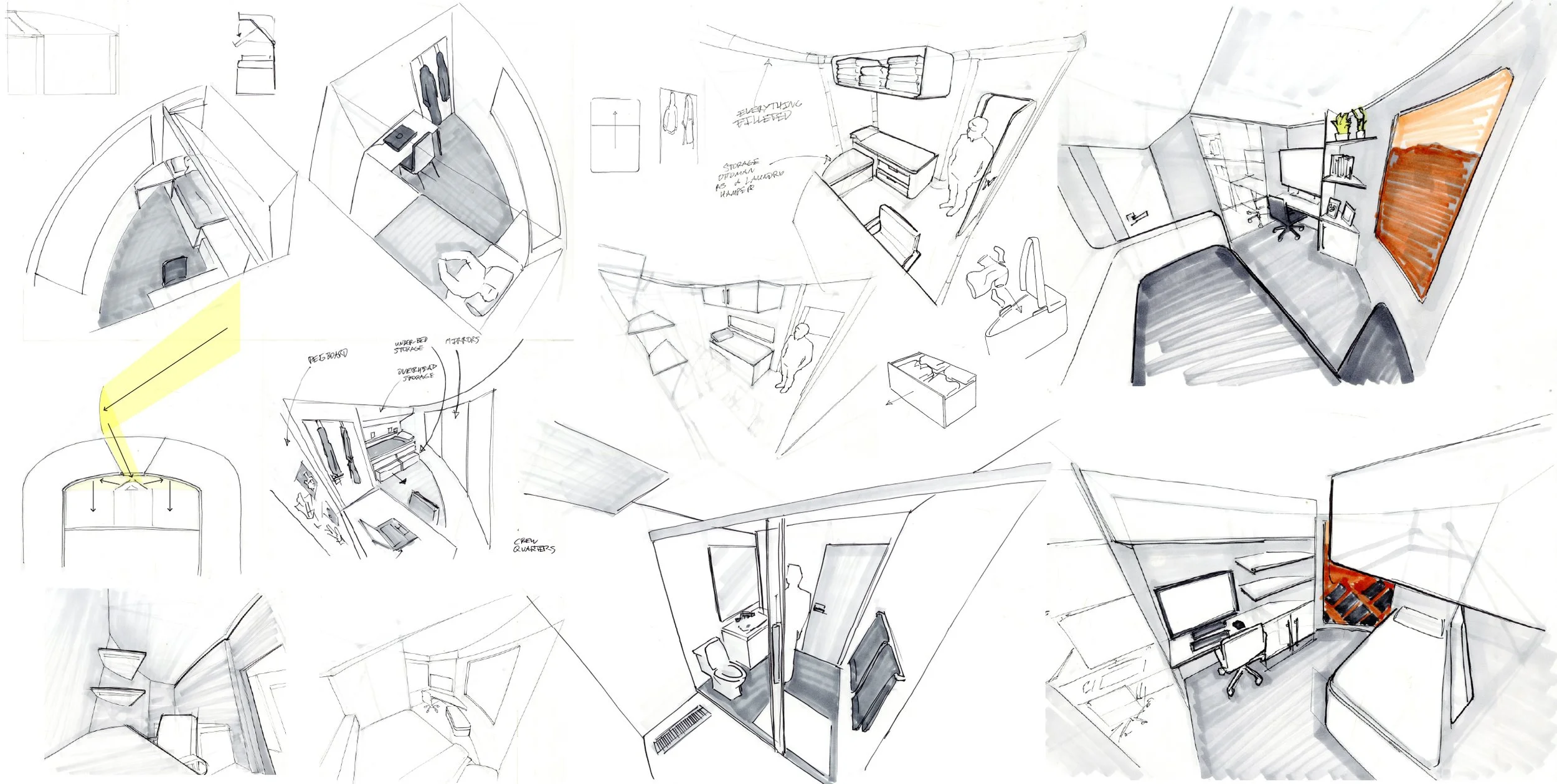
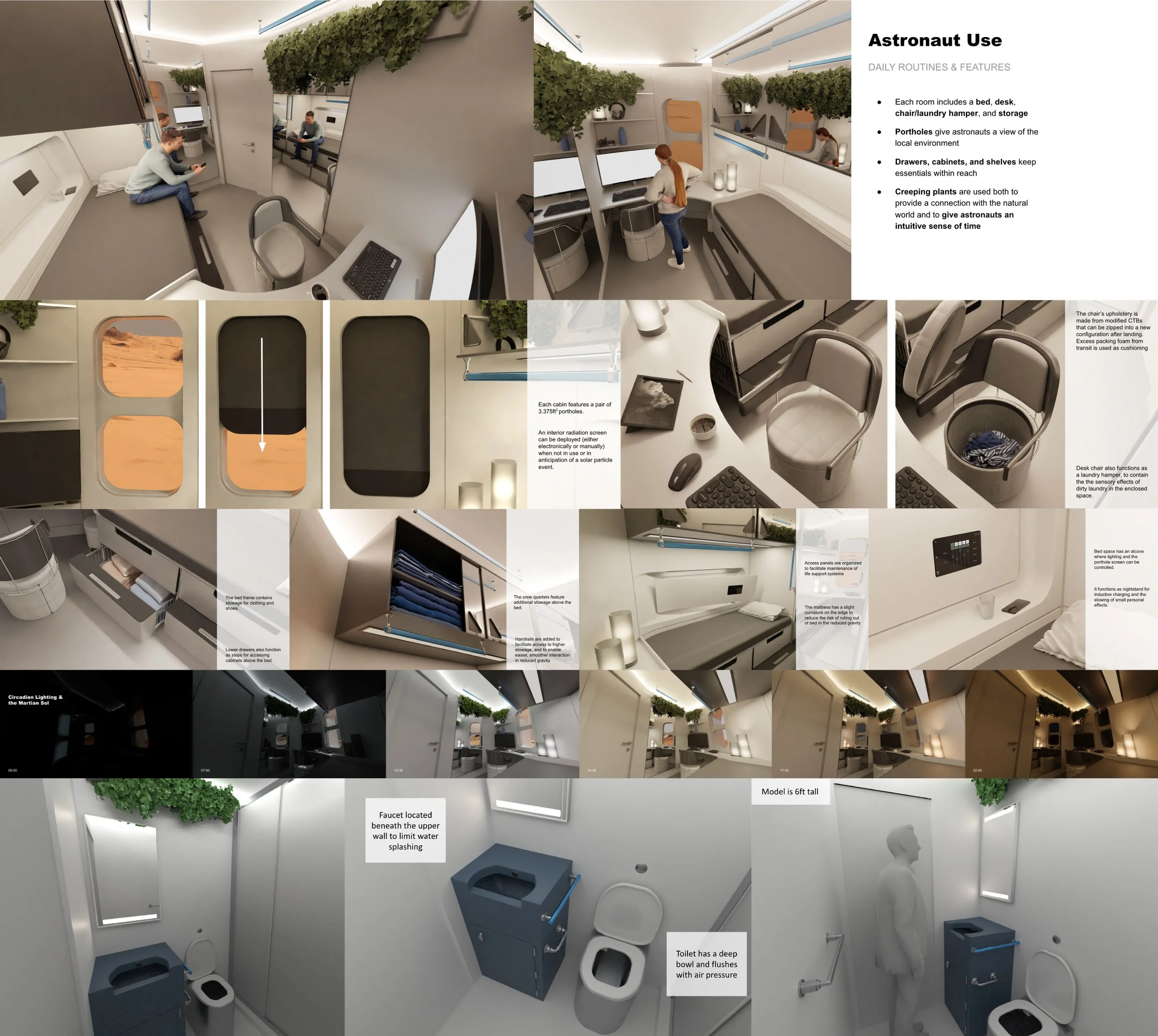
Soundproof walls minimize sleep disruption and provide privacy
4 private rooms with the same or mirrored layouts (62.7 ft2 each)
Bathrooms are shared by only two astronauts each for privacy and a sense of ownership of the space

Lighting cycles to reinforce astronauts’ circadian rhythms while living in an enclosed space
Astronauts can use lighting to customize their living space
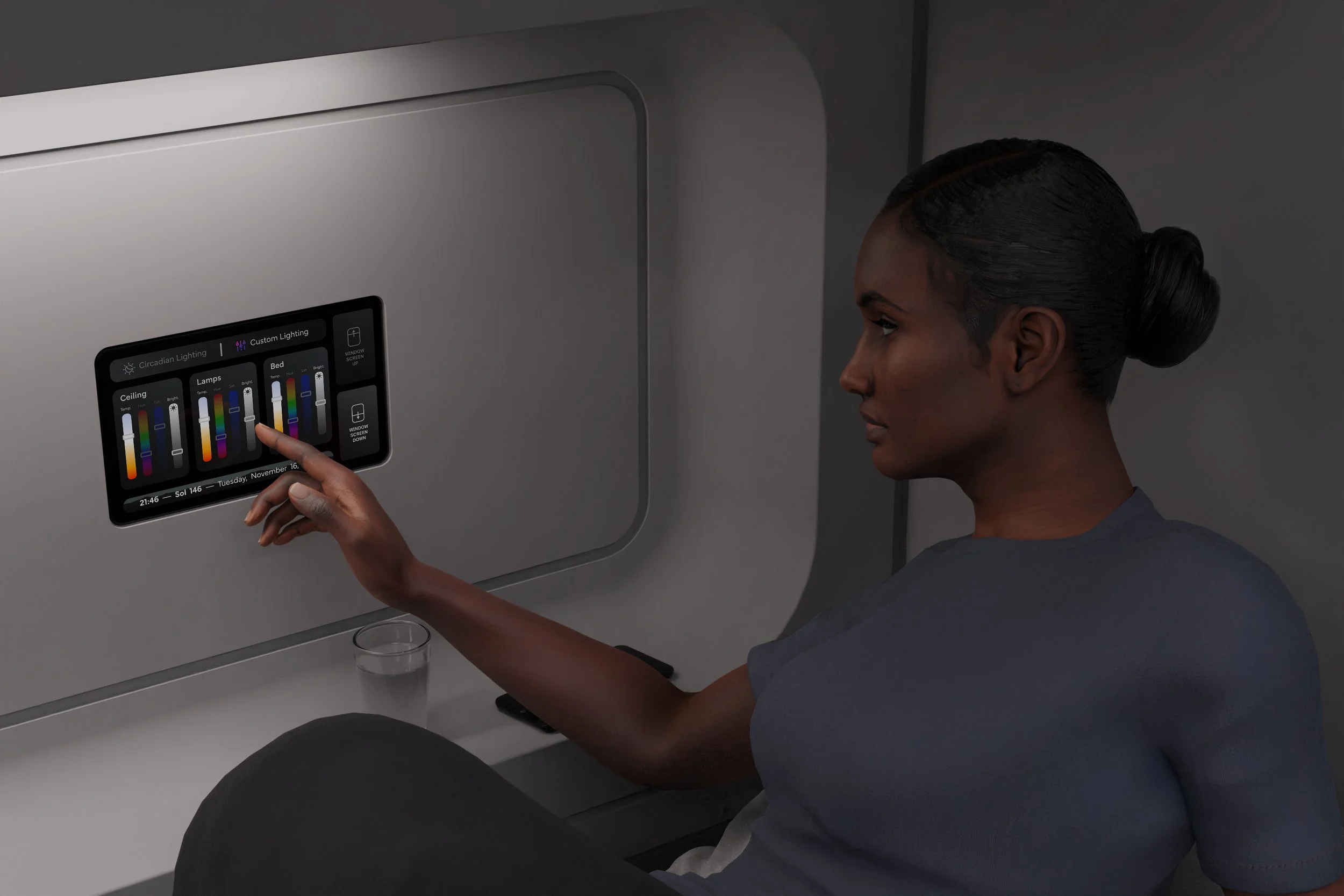
Control the lighting scheme and window screen from the bed
Conceptual Progression

Early Layout Concepts
Team Concept Review #1
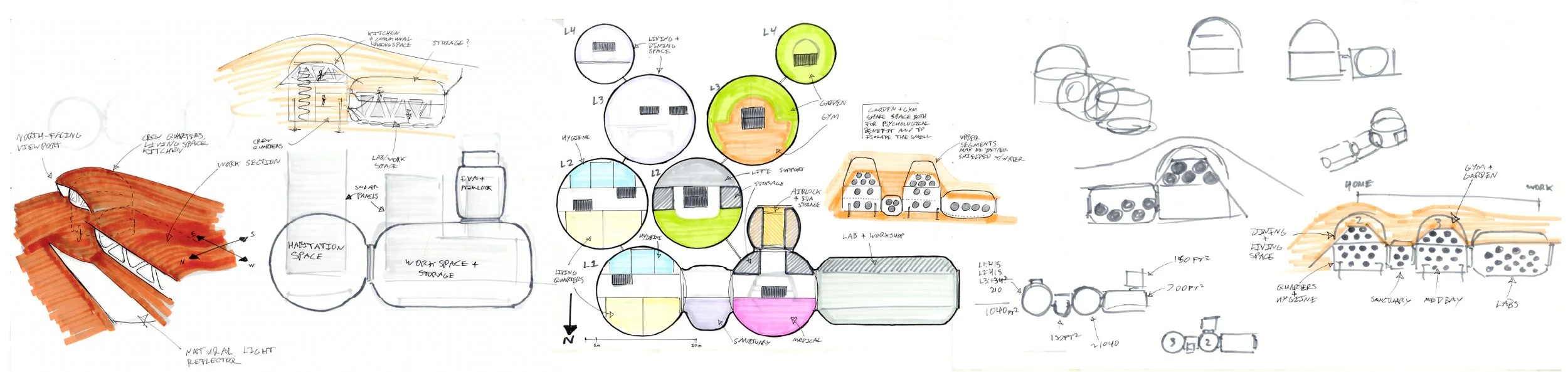
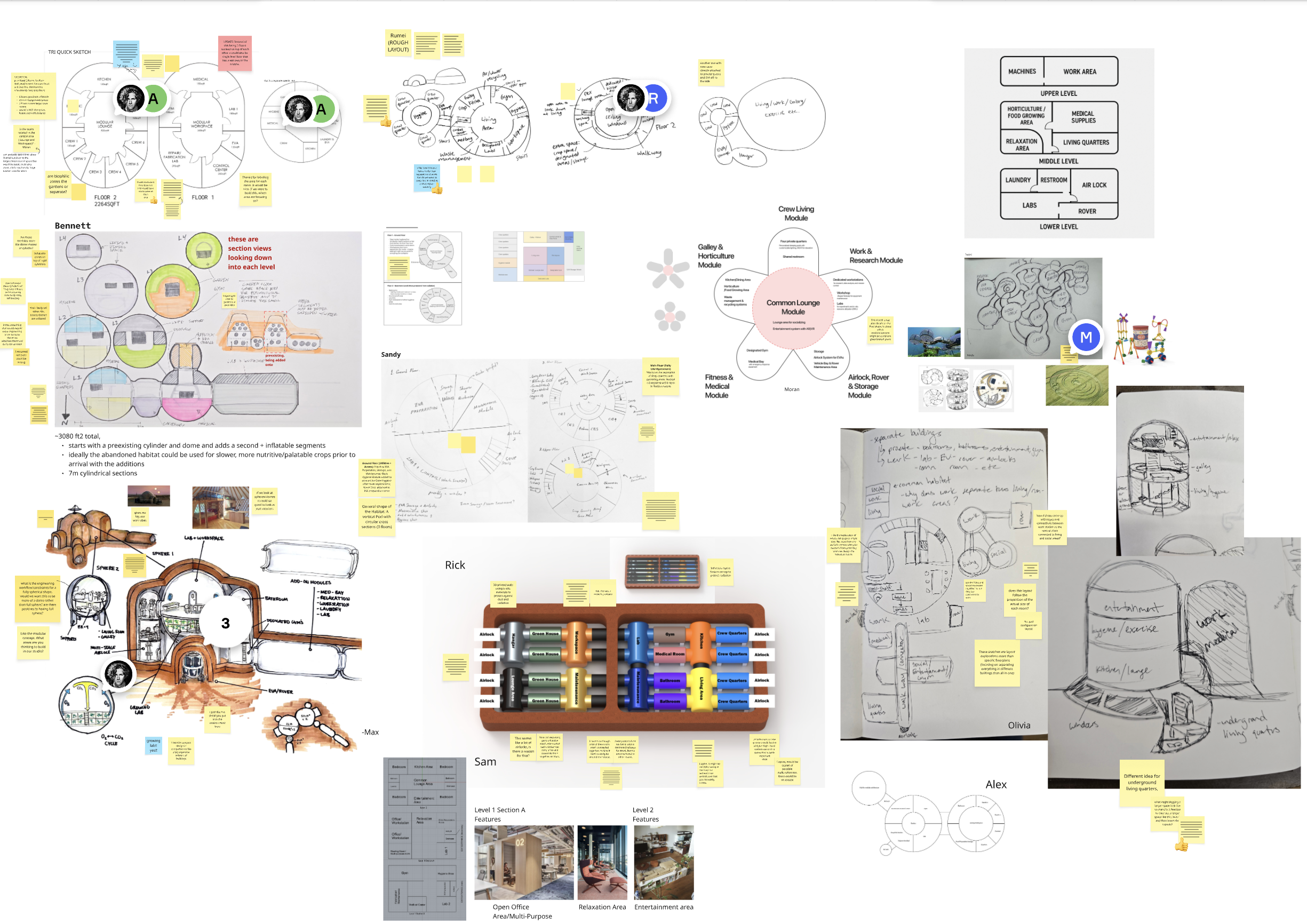
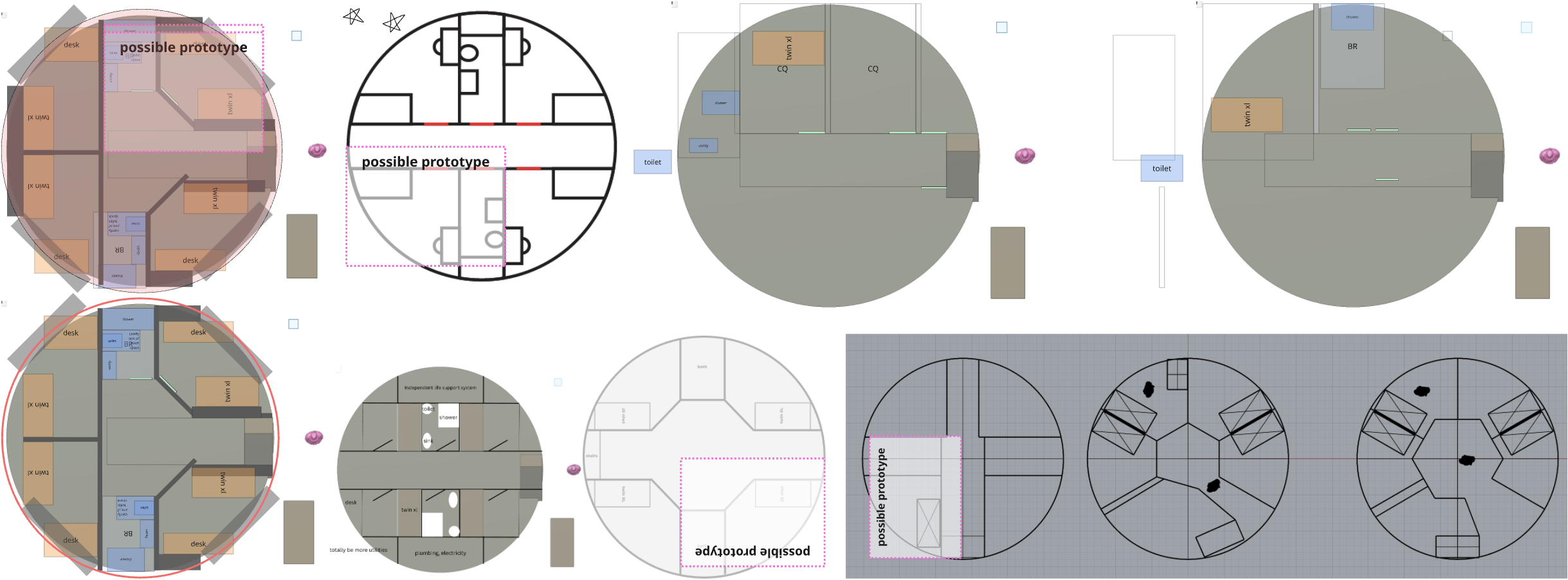
Individuals create distinct habitat concepts. The larger team discussed them, identified desirable features and configurations, and regrouped into small groups to continue development.
Team Concept Review #2
Individuals create distinct habitat concepts. The larger team discussed them, identified desirable features/configurations, and regrouped into small groups to continue development.
Final Layout
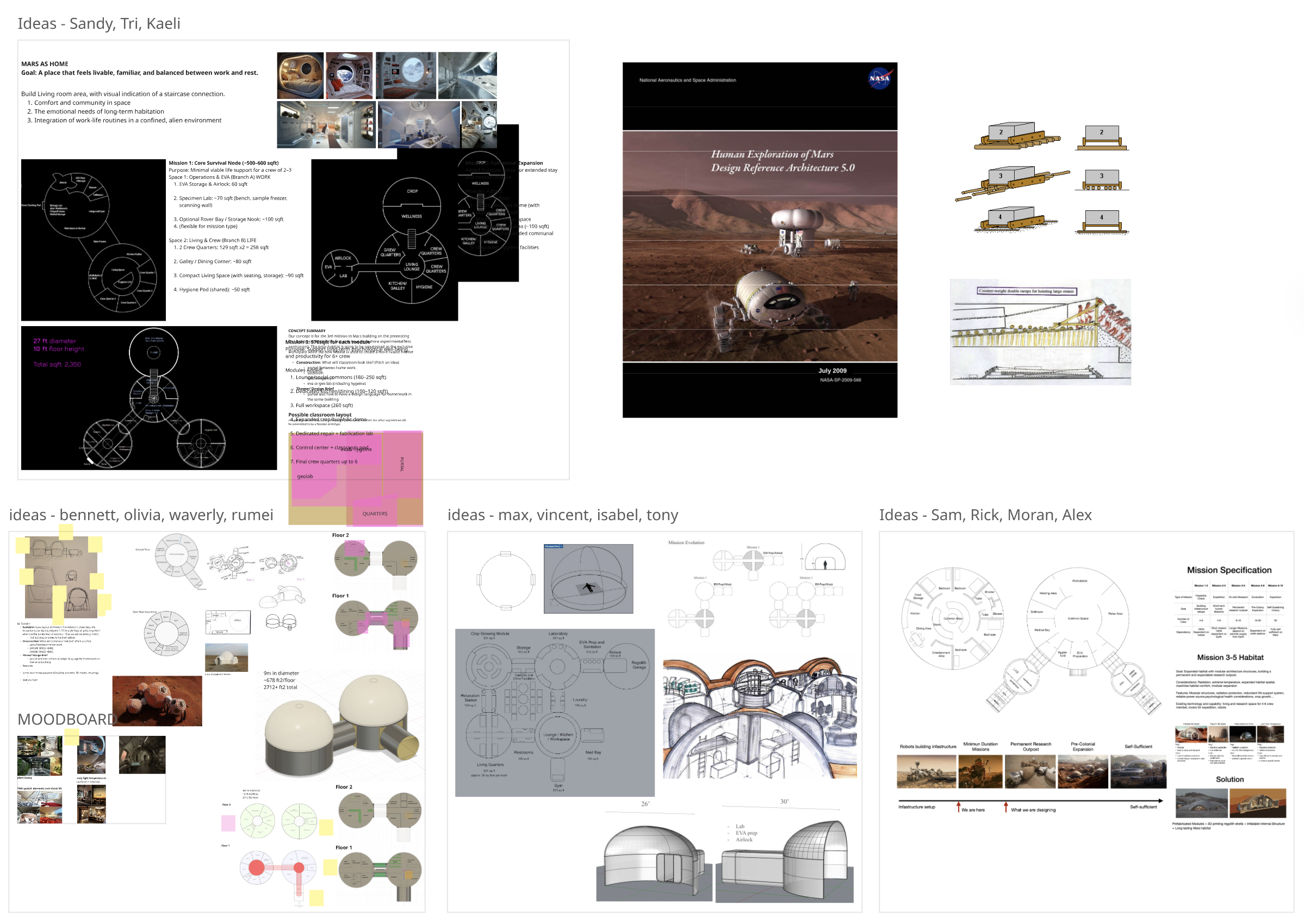
As a collective group we decided on a habitat layout.
*render came later in the process
Early Module 1 Layouts
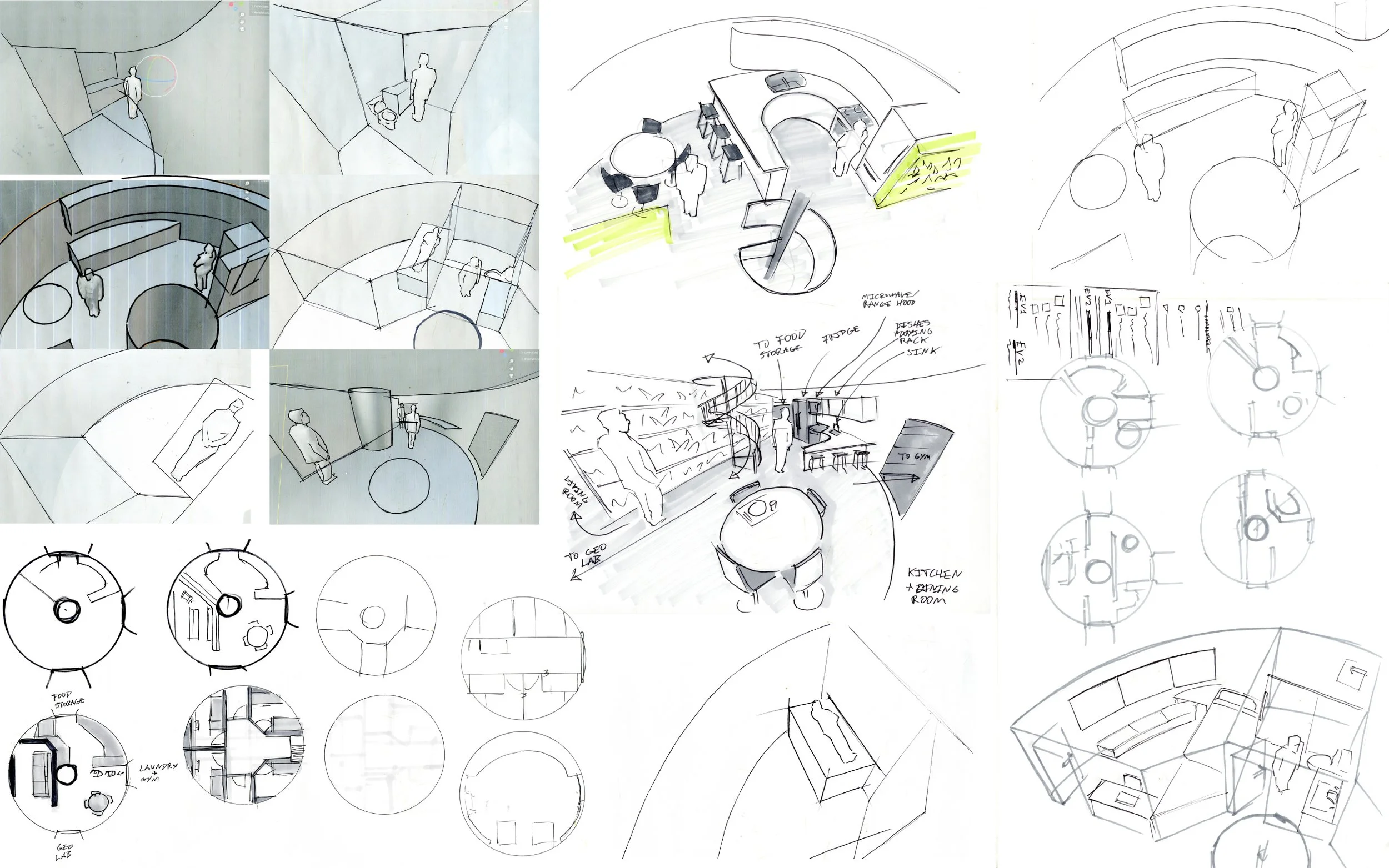
We divided into 4 groups of 3-4 to rough out the floor plan of each module. These are my sketches for the common area, galley, and crew quarters
Prototype Scope
We divided into 3 groups to go deeper, and where we could within the timeframe, we created a floor plan of the maximum portion of the habitat we could reasonably prototype in our studio. This meant we could prototype a large segment of the geology lab, most of the galley, and a complete bedroom and bathroom.
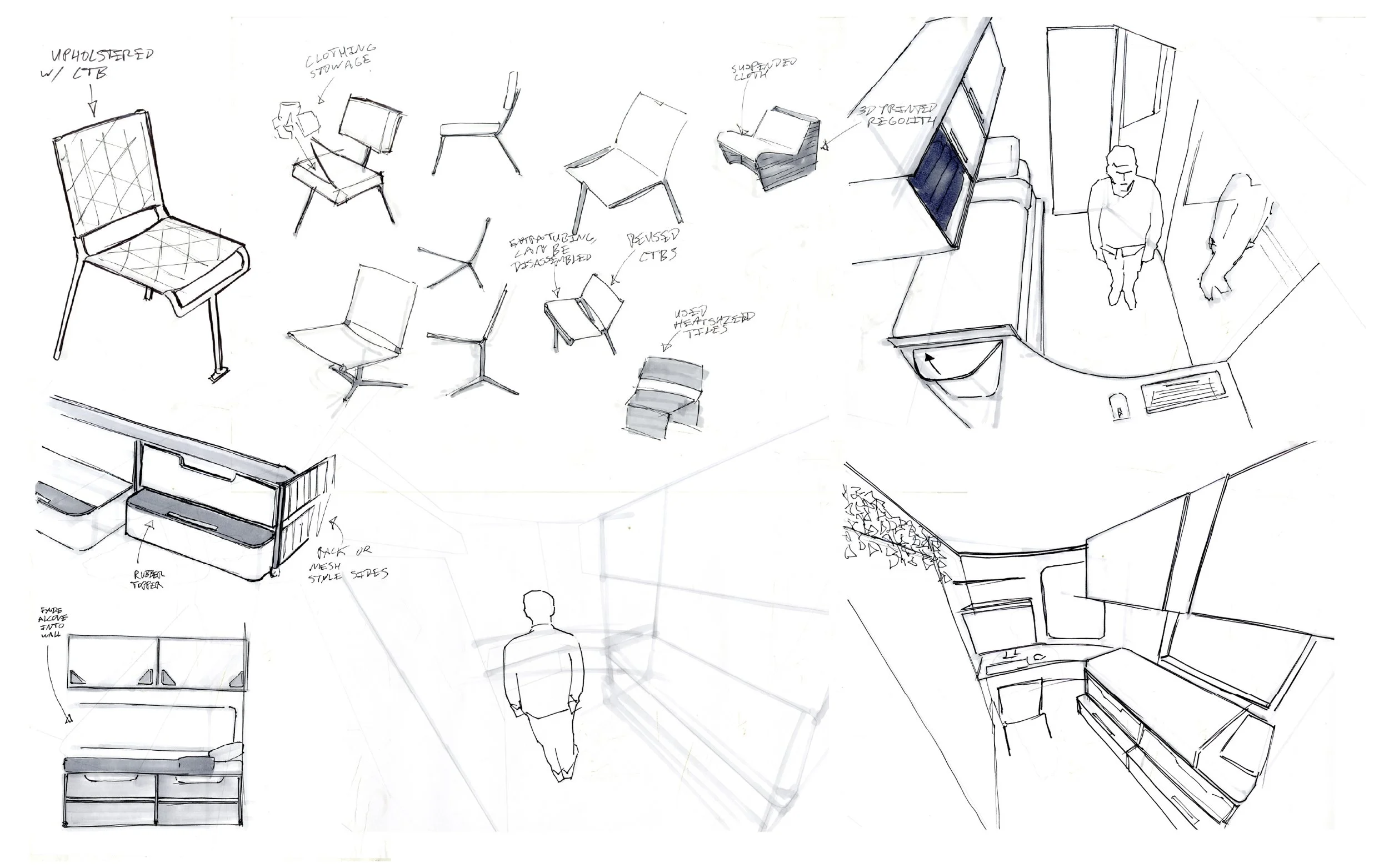
Crew Quarters Layouts
We divided into 4 groups of 3-4 to rough out the floor plan of each module. These are my sketches for the common area, galley, and crew quarters
Midpoint Review
We divided into 4 groups of 3-4 to rough out the floor plan of each module. These are my sketches for the common area, galley, and crew quarters
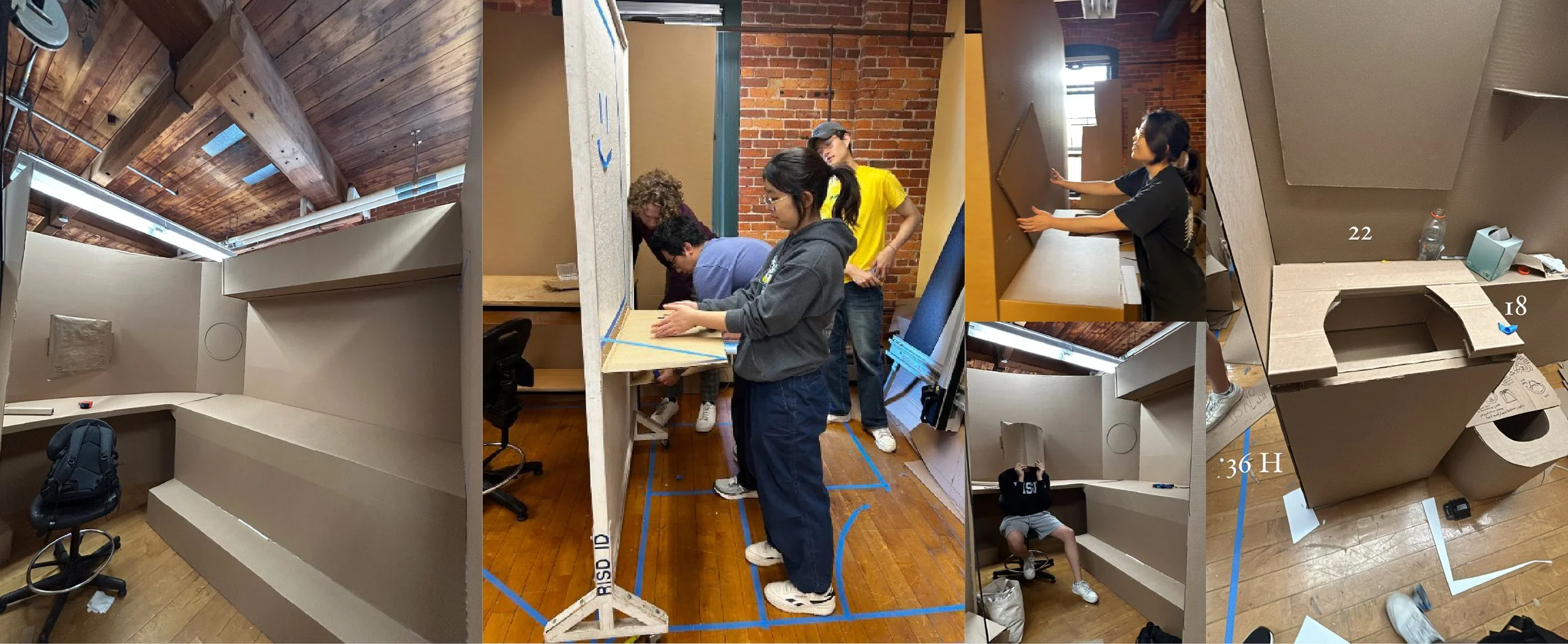
Cardboard Prototype
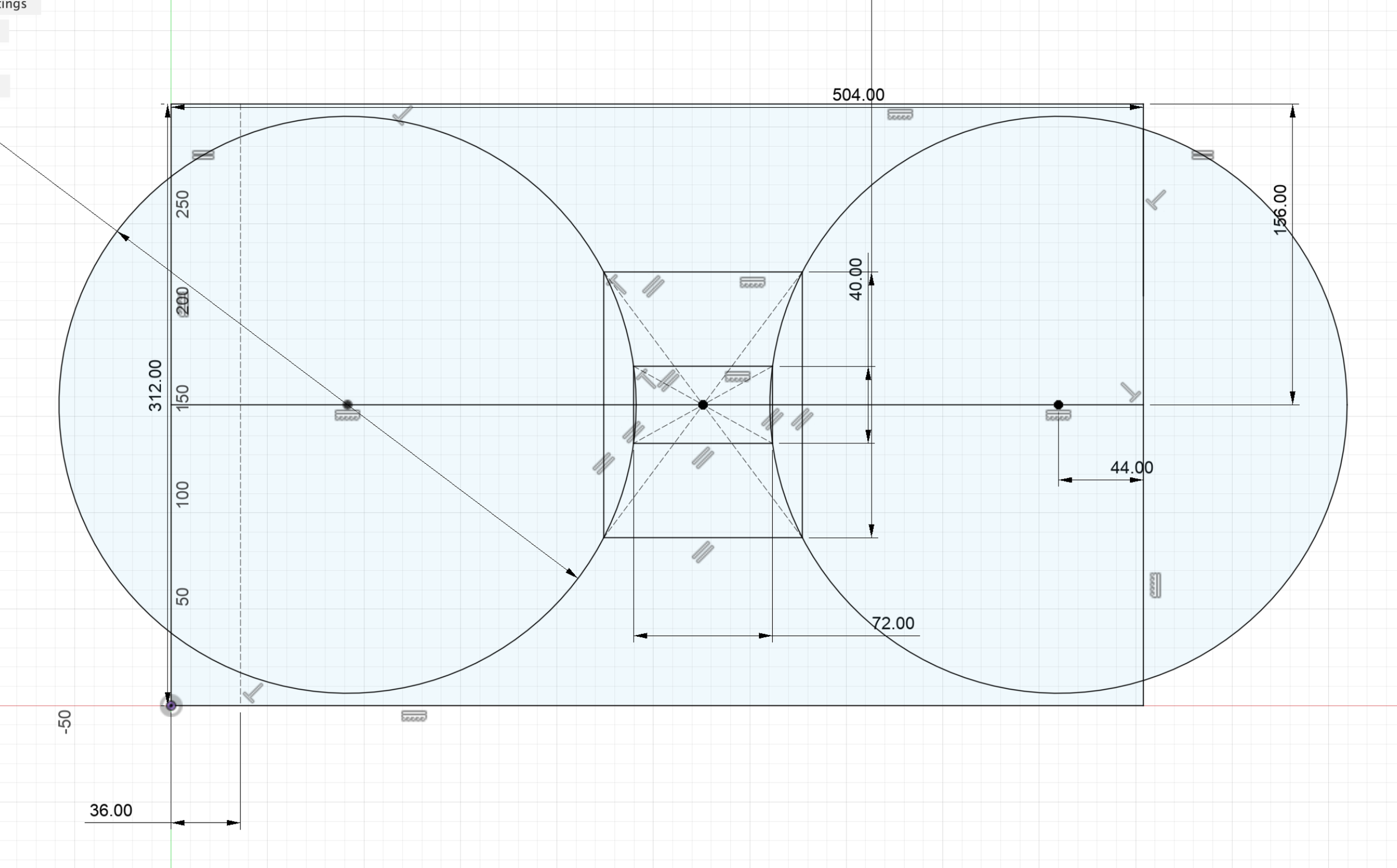
Around the time of our review, we worked through a cardboard mockup of the space. Around this point, we found out the module diameter we’d been assuming (9m, not including some external structures) was erroneous, and adjusted to an 8m exterior diameter, assuming the interior would be 6” inset. We used our mockup to rework the new smaller floor plan.
Details and Final Crew Quarters
We divided into 4 groups of 3-4 to rough out the floor plan of each module. These are my sketches for the common area, galley, and crew quarters
Final Prototype
We divided into 4 groups of 3-4 to rough out the floor plan of each module. These are my sketches for the common area, galley, and crew quarters
Final Presentation
We presented our concept to a panel of guest critics who were designers and engineers at NASA, Blue Origin, and Iceland Space Agency, where we got detailed feedback on our work.
Feedback
Ivy was a good choice for a plant to include because it has the additional benefit of showing the passage of time.
Circadian lighting was a good addition, but there should be an option to use the lighting to customize your space.
Multifunction and low-mass furniture was well-considered but with more time and opportunity there’s room to explore even further.
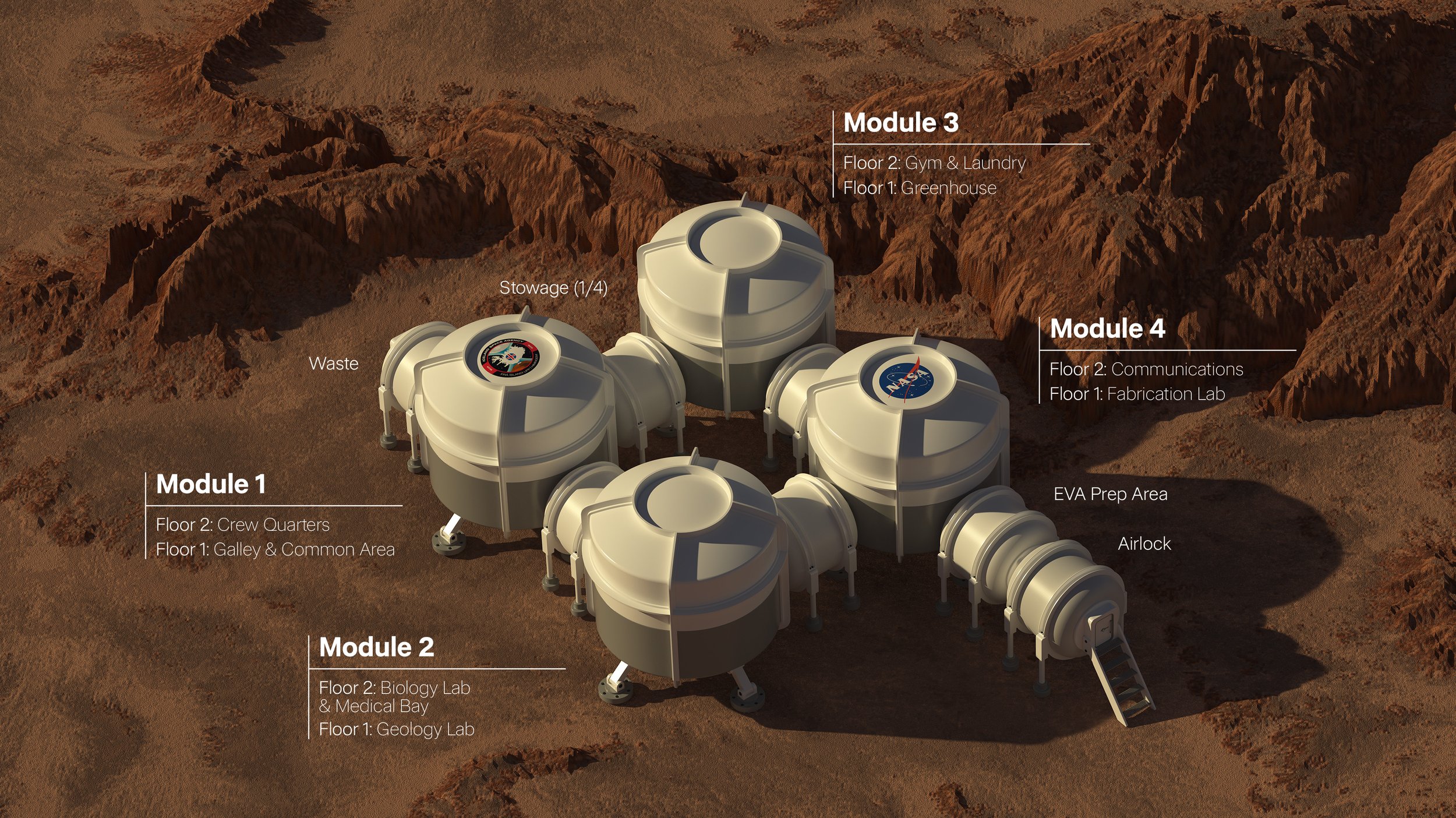
exterior render by Rick Fan
Temporary Sub-teams
Final Sub-teams
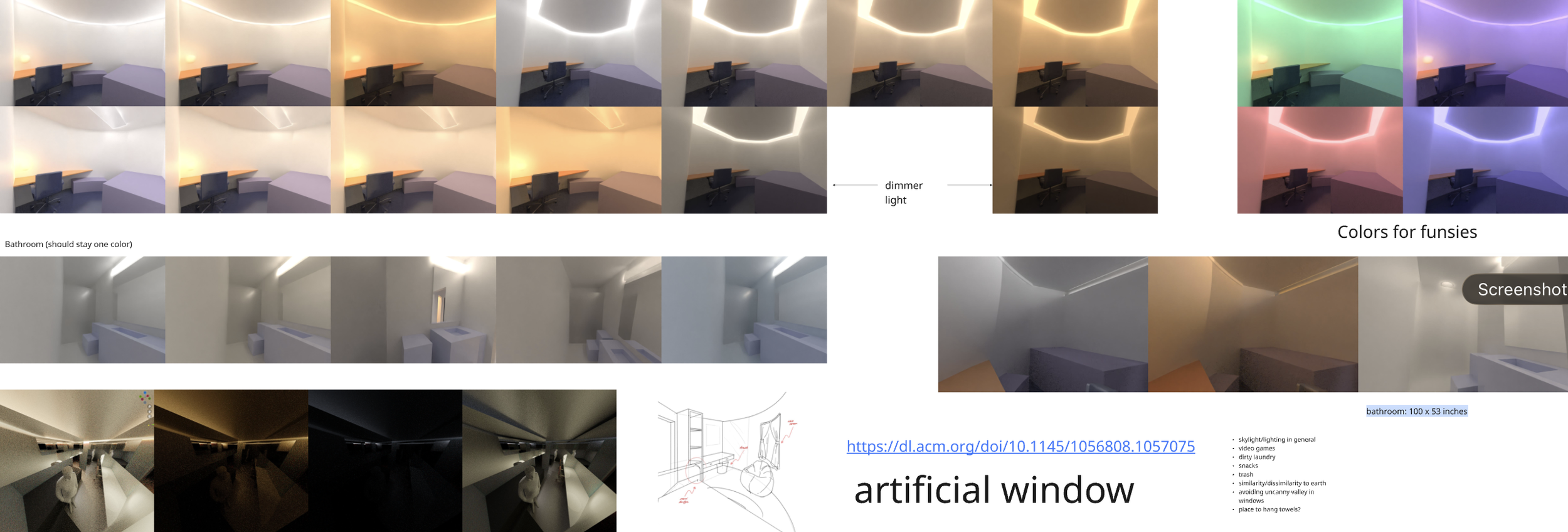
Above renders by Rumei Zha
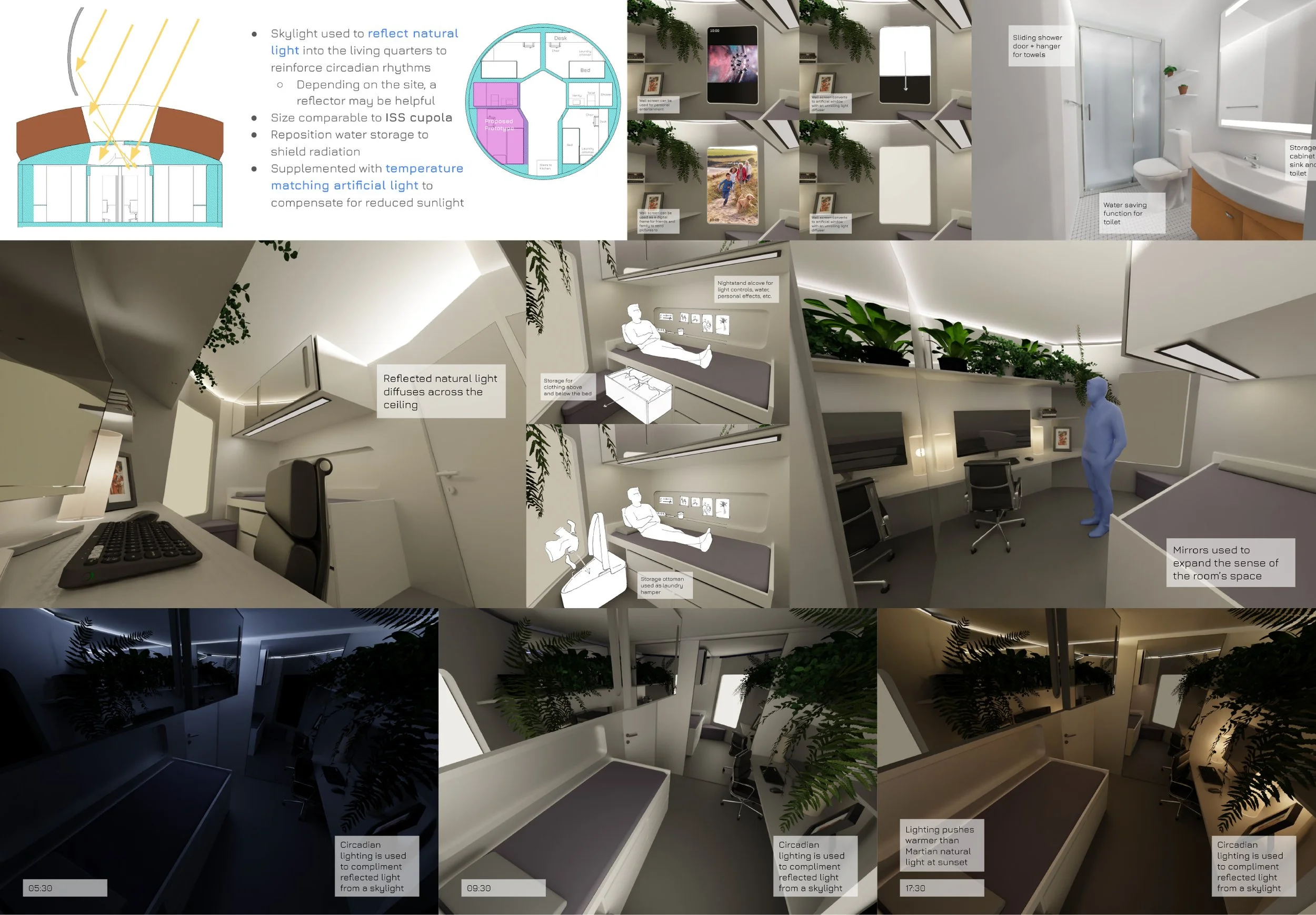
Render by Rumei Zha
Render by Rumei Zha
Render by Rumei Zha
Render by Rumei Zha