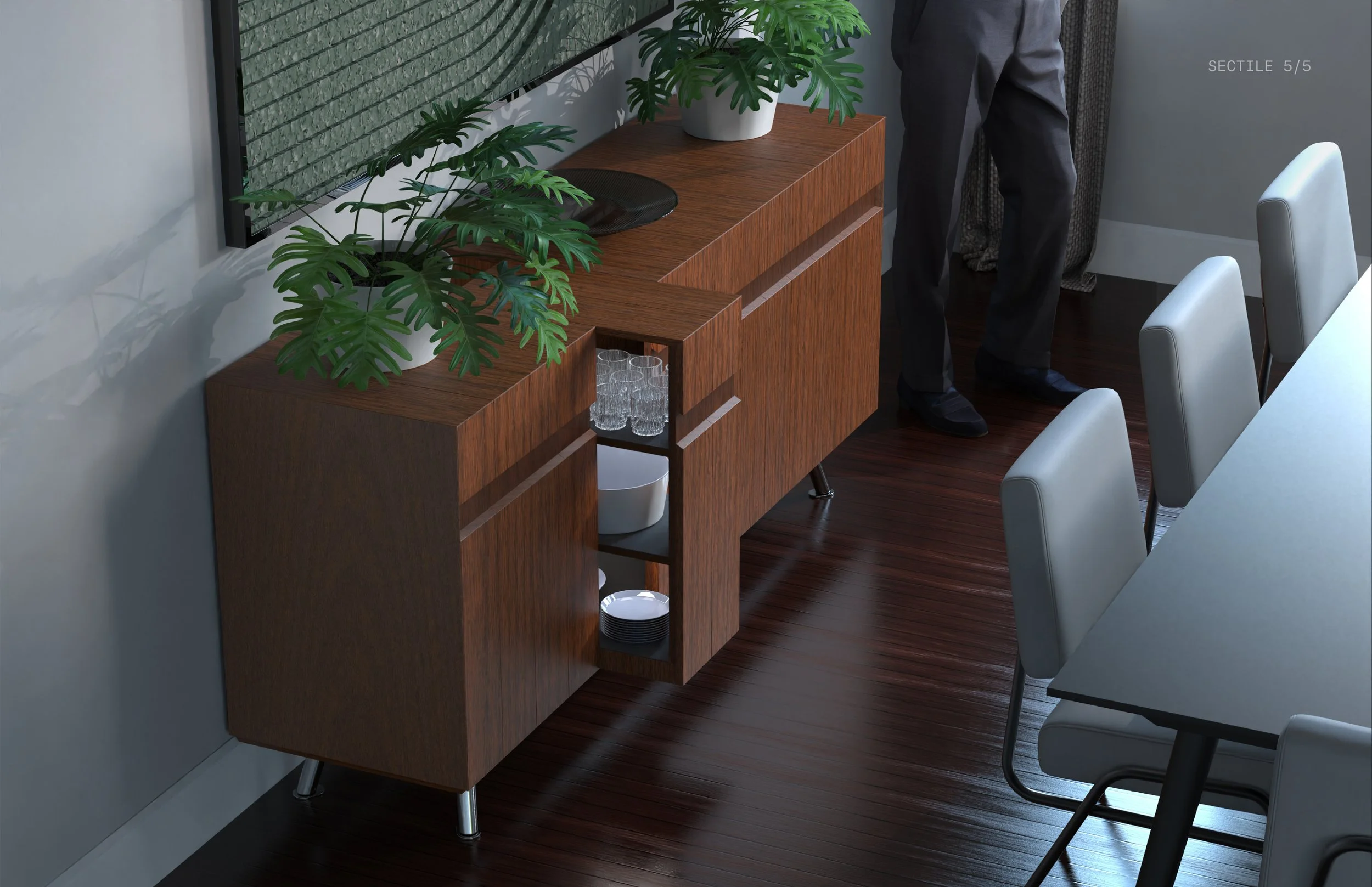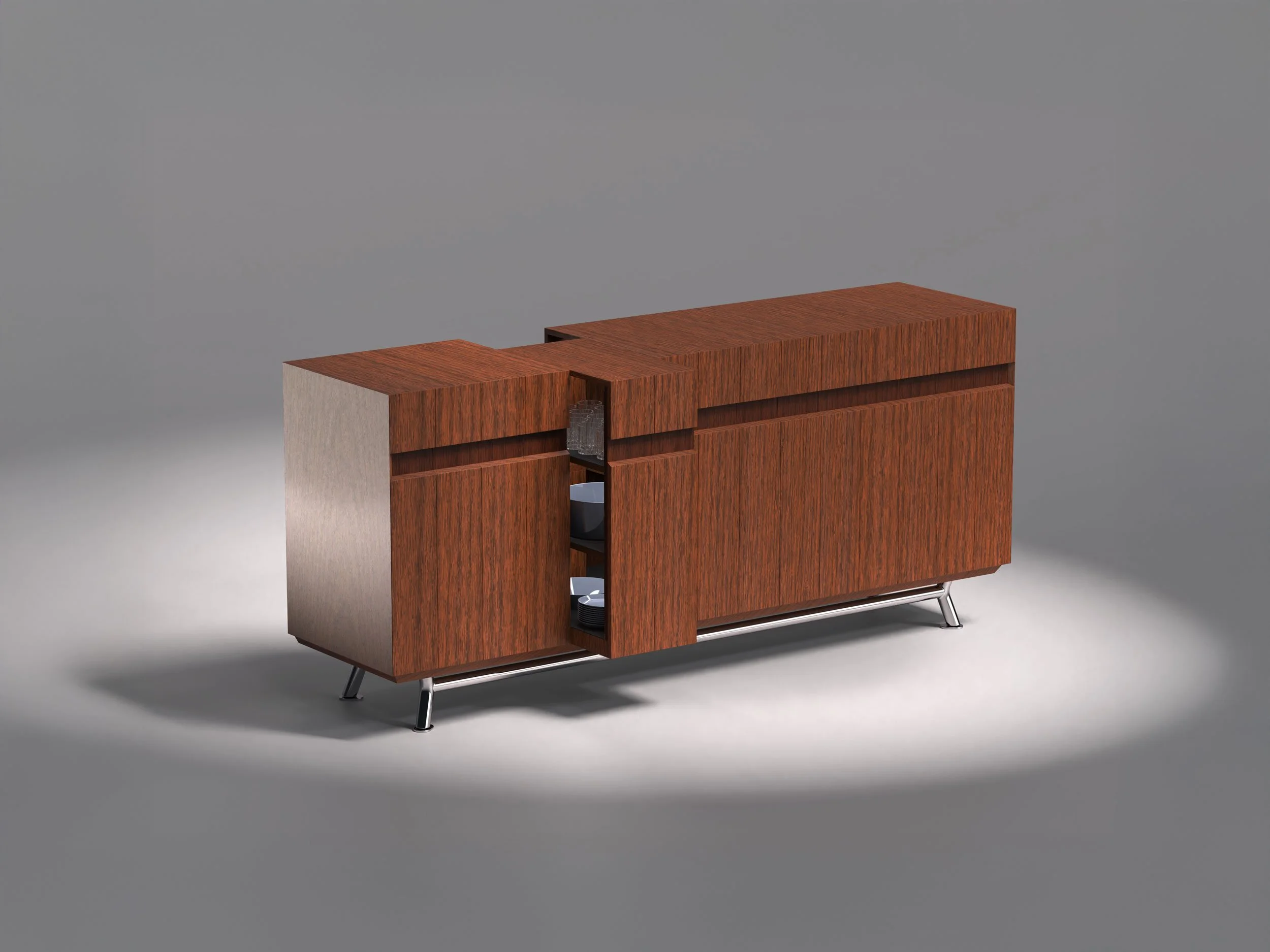
Sectile
Background
Duration: 5 Weeks
This design was created for the Philadelphia Museum of Art’s Collab Competition, where it was recognized as a notable design. The prompt was to create a design concept for a sideboard, cabinet, or console with inspiration from themes in the work of Sebastian Errazuriz.
Design Process
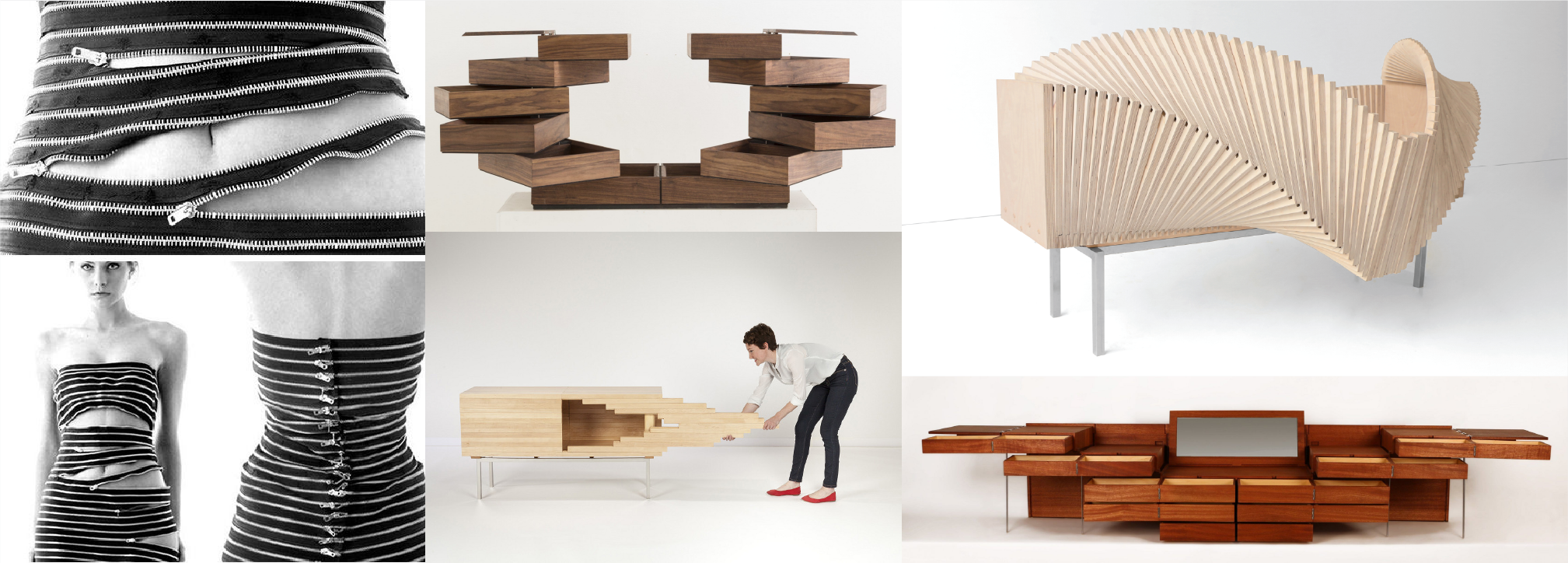
Inspiration
I was fascinated by a motif in much of Errazuriz’s work, where he uses the sum of repeated parts or mechanical connections to create an intriguing whole for a traditional product typology.
Program
User Attributes
Homeowner (with a dedicated dining area in their home)
Age 30+
Hosting is a major factor in the purchasing process
not limited by the constraints of small children
Function
Must be able to store and permit access to fine cutlery, plates, glasses, and other similar items
Must have a top surface that can be used as a functional top (e.g. hold a platter) and as a display surface (e.g. hold a potted plant)
Ethnography
I conducted ethnographic research of both sideboards as well as dining area storage furniture more broadly. The items being stored were highly variable, so the end product would need to accommodate a range of items (e.g., silverware, glassware, trays, baking implements, party supplies, beverages, etc.).
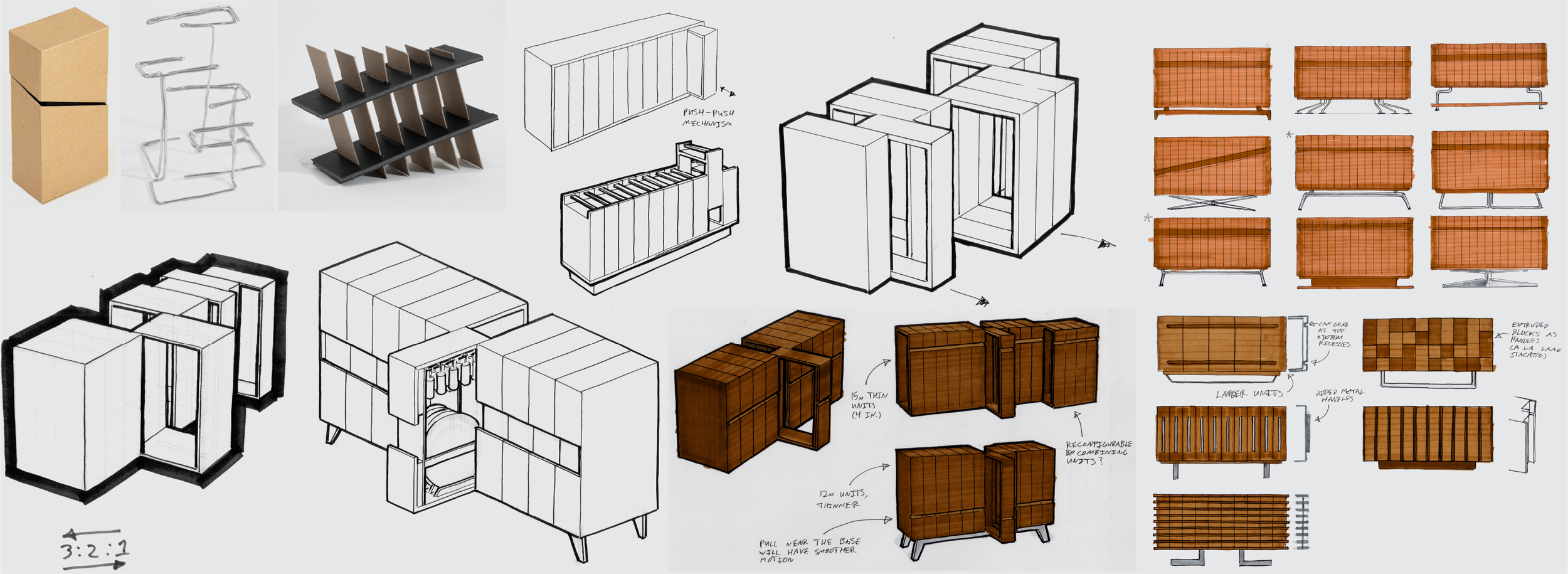
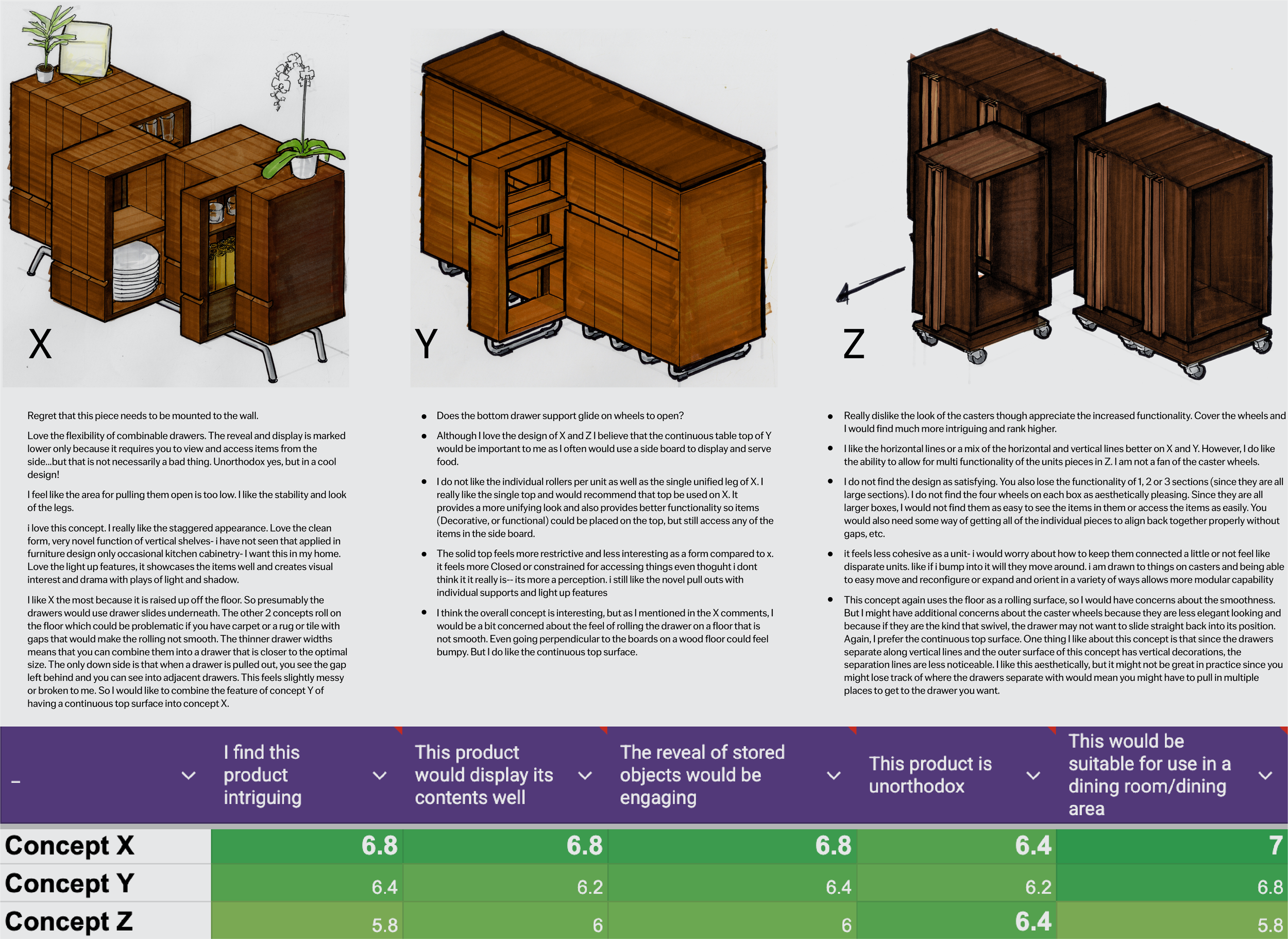
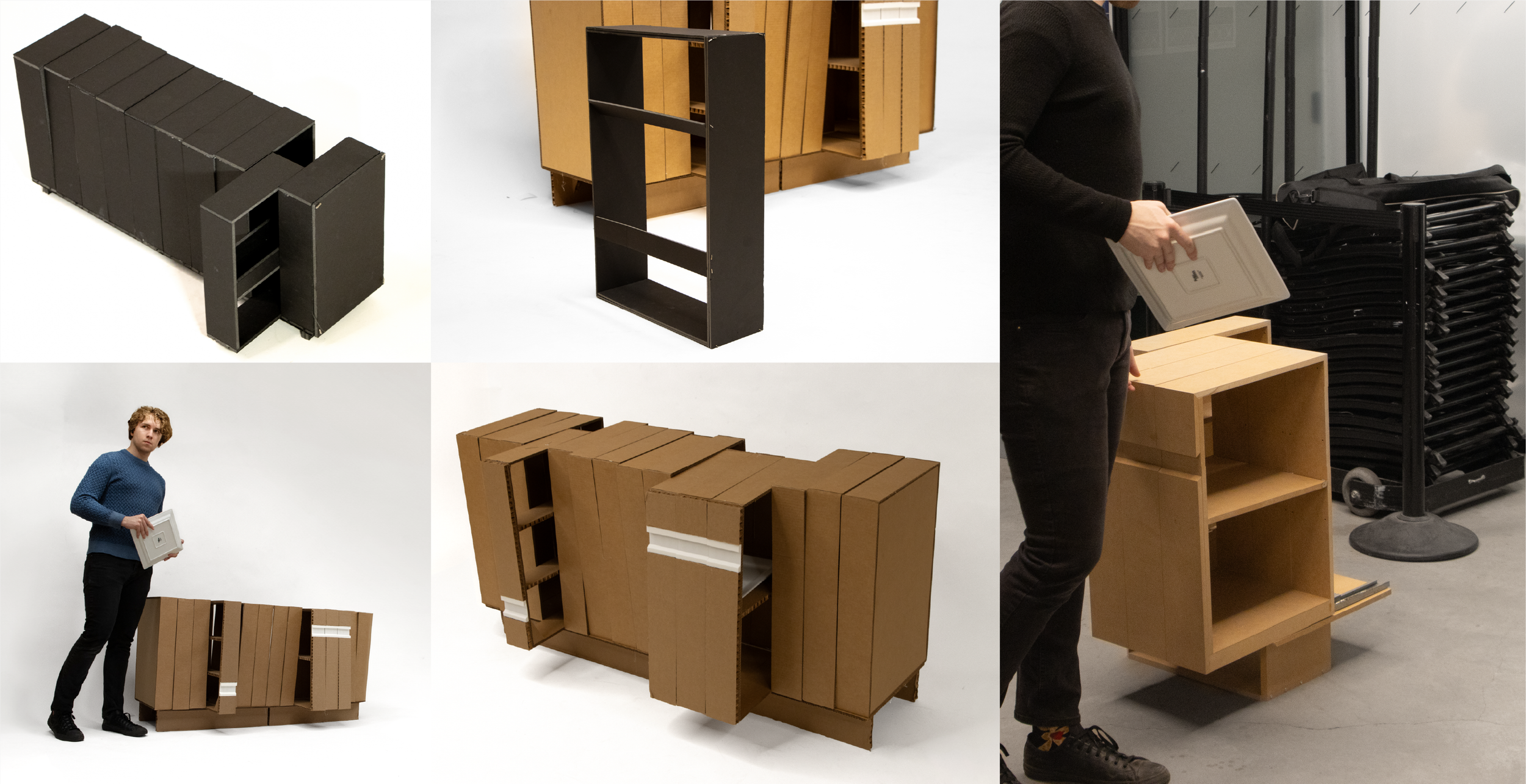
Early on, I started exploring the idea of a sideboard with vertical drawers. I found the rhythm to be an interesting opportunity so I sketched and prototyped variations on the idea.
Feedback & Emotional Mapping
To get user input, I presented users with variations to get feedback. The format I chose had participants provide open-ended feedback and quantitative comparisons for emotional mapping of desirable attributes.
Prototyping
Along the process, I made scale and full-size prototypes to guide the process.
Near the end, I made a fully functional full-scale prototype of a segment (4 of 15 drawers) out of MDF, to test the undermount drawer mechanism and reconfigurable/combinable drawers, and what it would be like to use and interact with more broadly.
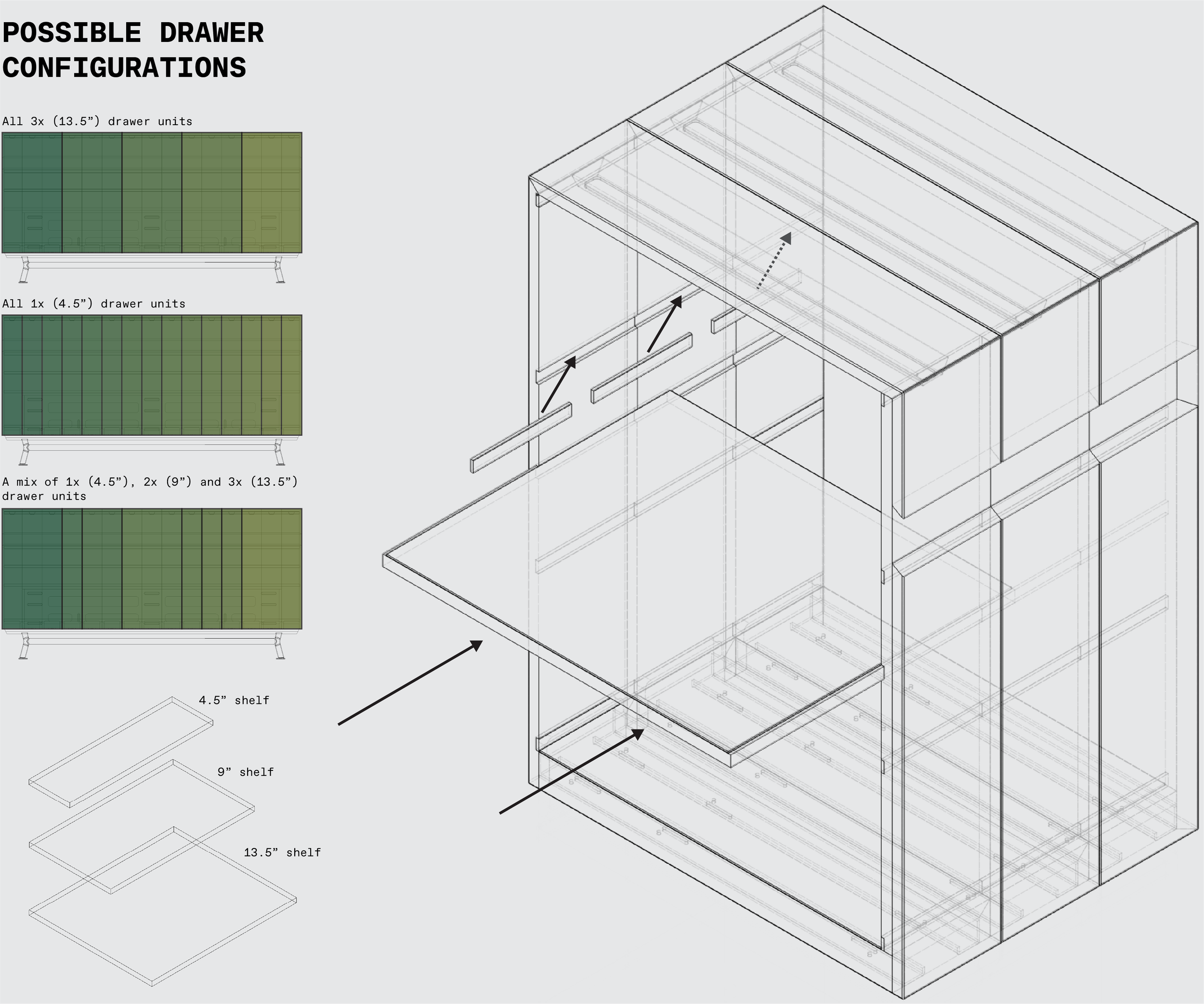
Each vertical drawer is 4.5” wide. Sectile comes with shelves that can be slotted into the drawers to combine up to 3 of them into a single unit (with shelves at 1/2 or 1/3 increments). The end user can choose the best configuration for their storage needs. Unused shelving slots can be filled with press-fit parts that visually blend in with the interior.
Features
Almost all major components are hardwood boards, stainless steel tubing, or sheet metal, and can be easily manufactured at a large scale with industrial means.
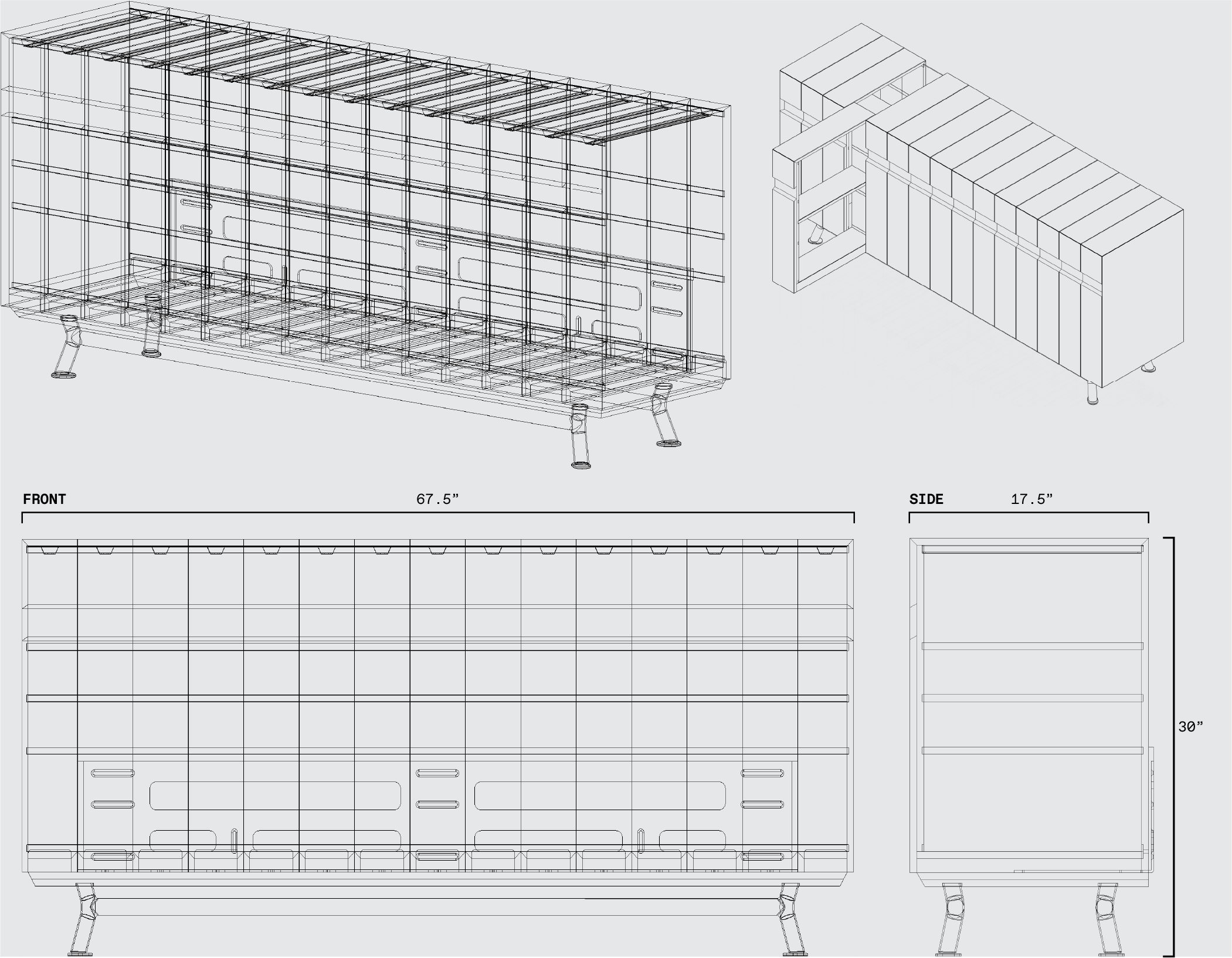
The total volume of the sideboard is 67.5” x 17.5” x 30”, aligning the top with the average dining table.
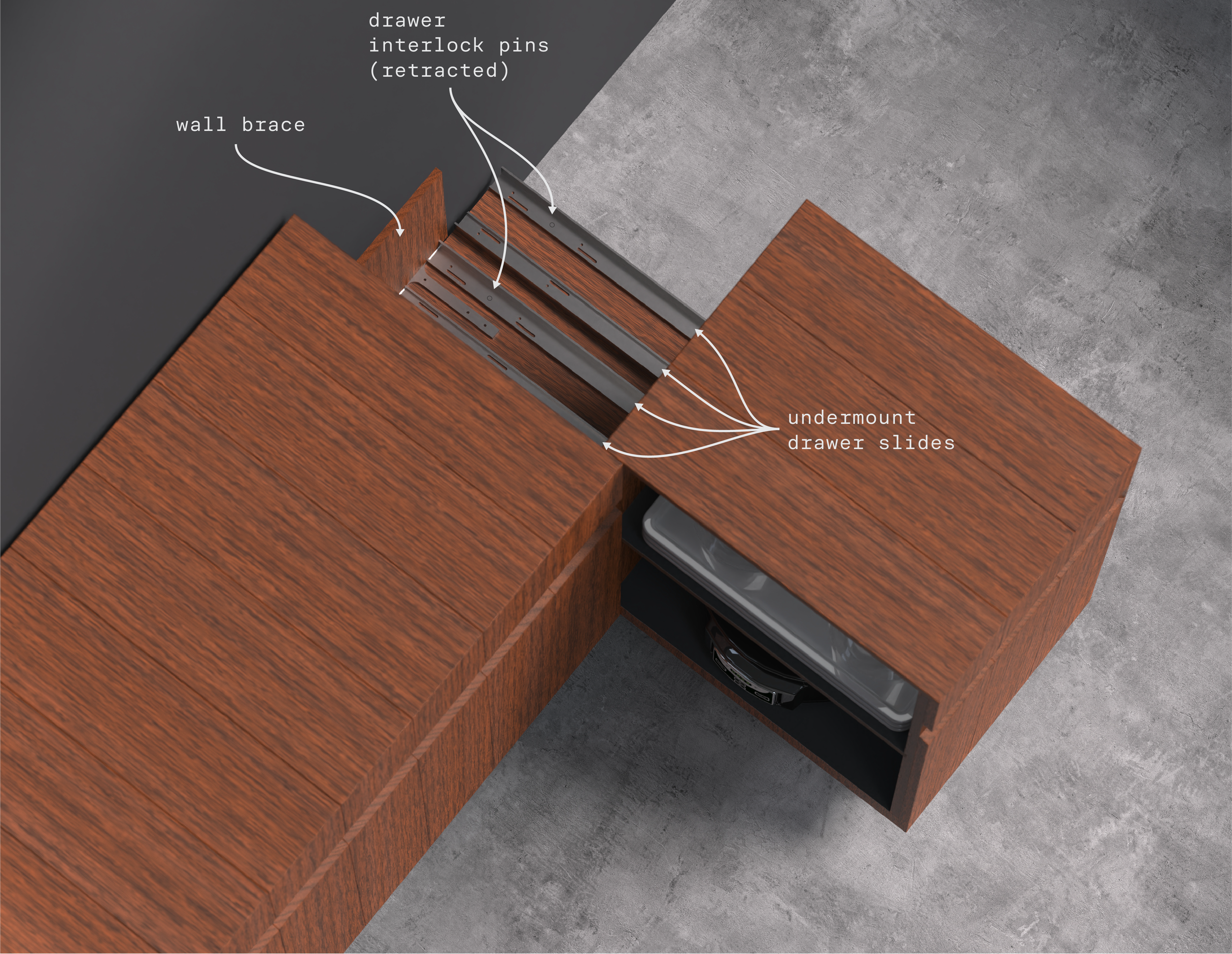
The drawer units are able to extend up to 17” from their flush resting position, so the entire interior can be easily accessed. To accommodate this structurally and mechanically, each drawer unit has a pair of undermount drawer slides (with damping on close, which was used in the functional prototype).
Additionally, there is a wall-mounting bracket that attaches to the base (this is concealed by a wood panel). For extra safety and stability, the sideboard uses a drawer interlock mechanism (as used in many tool cabinets) to permit only one drawer unit to be open at a time.
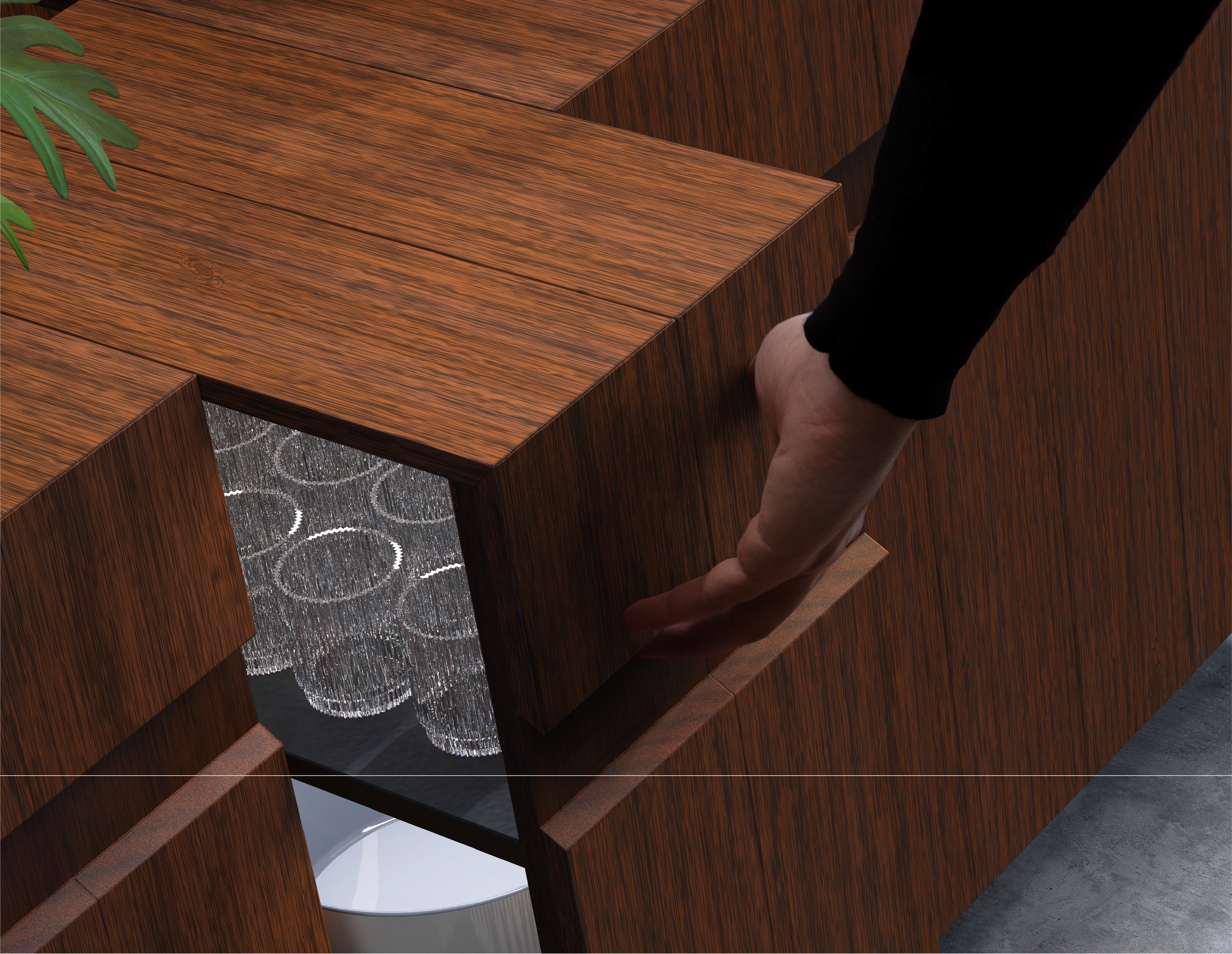
The drawers feature internal illumination when opened, which facilitates display and adds drama to the reveal of contained items, as well as improving the functional experience.
Drawer shelves are lined with pads both to protect fragile items and to dampen sound and prevent rattling.